
Upgrade je HR-activiteiten en optimaliseer de ervaring van je werknemers met de Human Resource Management-oplossing van Priority. Priority's Human Resource Management-oplossing stelt jou in staat om HR-processen te stroomlijnen en de volledige levenscyclus van werknemers te beheren. Met real-time analyses en aanpasbare workflows kun je het volledige potentieel van jouw personeelsbestand benutten en het bedrijf verbinden met zijn belangrijkste troef – de werknemers.

Automatiseer, reguleer en centraliseer HR-processen
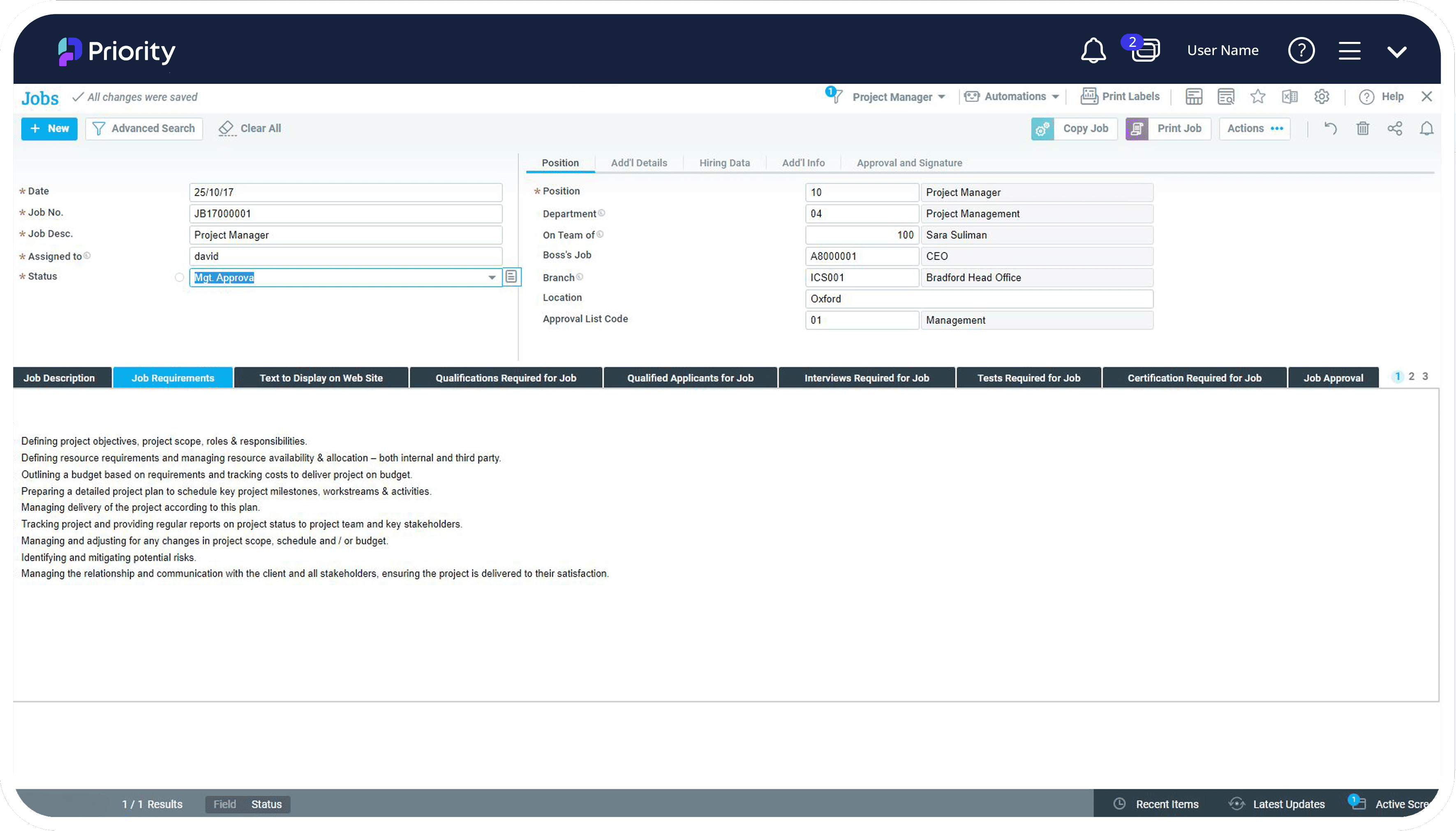

Wil je Priority in actie zien?
Maak prioriteit van je personeel met Priority's HRM-oplossing


Belangrijkste functies
Budget en kosten
Beheer jouw HR-budgetten en -kosten als een pro.
Onze software stelt jou in staat om aanwervingen af te stemmen op het bestaande personeelsbestand en kosten te voorspellen.
U kunt factureerbare en niet-factureerbare parameters bepalen voor HR-projecten en de totale projectkosten berekenen op basis van mijlpalen, taken en middelen.
Toegang op basis van functies
Met onze geavanceerde rolgebaseerde beveiliging kunnen bedrijfsleiders, managers, supervisors en medewerkers op een veilige manier toegang krijgen tot specifieke delen van de HR-module.
Dit geeft inzicht in de up-to-date team- en werknemersgegevens die nodig zijn voor de dagelijkse werkzaamheden. Onze HR-beheermodule biedt organisaties een compleet overzicht van hun personeelsbestand, inclusief trends, groei en omzet, per afdeling, locatie, personeelsklasse.
Dankzij de flexibele filters kunnen HR- en andere managers bovendien snel specifieke groepen werknemers bekijken en beheren.
Tijdregistratie
De HR-module bevat een functie voor tijdregistratie die zorgt voor een complete oplossing om real-time aanwezigheid, ziekteverlof en vakantierapportage bij te houden.
Via een mobiele app kunnen werknemers gemakkelijk gewerkte uren in real-time rapporteren in een database die het salarissysteem automatisch bijwerkt.
Beheer van personeelsdossiers
Volledig beheer van personeelsgegevens, inclusief certificeringen, kwalificaties, werk-, evaluatie-, cursusgeschiedenis en meer.
Beheer van Arbeidsovereenkomsten
Beheer alle aspecten van arbeidsovereenkomsten, inclusief de wekelijkse arbeidsduur, speciale voorwaarden, overurenlimieten, standaard aantal uren/afwezigheidsdagen en meer.
Krachtige Platformmogelijkheden
Dankzij het flexibel en open ERP-platform van Priority kunnen bedrijven groeien, zich snel aanpassen aan veranderende bedrijfsbehoeften en het platform naadloos integreren met andere bedrijfsmanagementsystemen, zoals payroll- en recruitmentsystemen.
Casestudies
ERP


ERP
FAQs
Is HR ERP hetzelfde als een HCM-systeem?
HR ERP (Human Resources Enterprise Resource Planning) en HCM (Human Capital Management)-systemen zijn gerelateerd, maar niet hetzelfde. HR ERP verwijst naar de HR-module binnen een geïntegreerd ERP-systeem dat verschillende HR-functies beheert, zoals salaris- en bonusadministratie, tijd- en aanwezigheidsregistratie en werknemersrecords als onderdeel van een breder scala aan bedrijfsfuncties. Aan de andere kant zijn HCM-systemen standalone softwareoplossingen die specifiek zijn ontworpen om de volledige levenscyclus van het personeelsbestand van een organisatie volledig te beheren, met betrekking tot aspecten als werving, talentmanagement, prestatiebeheer, leren en ontwikkeling en werknemersbetrokkenheid. Hoewel beide systemen HR-gerelateerde taken afhandelen, biedt HCM een meer gespecialiseerde en diepgaande focus op strategisch human resource management, terwijl HR ERP geïntegreerd is in een breder bedrijfsbeheerplatform, dat andere modules zoals financiën, toelevering en verkoop kan omvatten.
Kan HR ERP omgaan met de behoeften van grote organisaties met een divers personeelsbestand?
Ja, HR ERP-systemen zijn ontworpen om te voldoen aan de behoeften van grote organisaties met een divers personeelsbestand. Deze systemen zijn schaalbaar en geschikt voor een aanzienlijk aantal medewerkers en complexe HR-processen. HR ERP biedt de tools en functionaliteiten die nodig zijn om diverse HR-taken te beheren, zoals salarisadministratie, arbeidsvoorwaardenadministratie, personeelsdossiers, prestatiebeheer en tijd- en aanwezigheidsregistratie voor een groot en divers personeelsbestand. Bovendien kan HR ERP meerdere landen- en meertalige mogelijkheden ondersteunen, waardoor wereldwijde organisaties HR-activiteiten op verschillende locaties kunnen beheren en tegelijk kunnen voldoen aan diverse arbeidswetten en -voorschriften. De uitgebreide functies van het systeem en de integratie met andere bedrijfsfuncties maken het zeer geschikt voor grote organisaties met complexe HR-vereisten, waardoor gestroomlijnde HR-processen, verbeterd personeelsbeheer en verbeterde HR-besluitvormingsmogelijkheden worden gewaarborgd.
Kan HR ERP helpen bij het zoeken en aanwerven van talent?
Ja, HR ERP kan helpen bij het zoeken naar talent en aanwervingsprocessen. Deze systemen bieden speciale modules of functionaliteiten om verschillende aspecten van werving te stroomlijnen en te automatiseren, van het plaatsen van vacatures en het werven van kandidaten tot het volgen van sollicitanten en het plannen van sollicitaties. HR ERP stelt organisaties in staat om vacatures te maken en te beheren, sollicitaties van kandidaten te volgen en sollicitatiegegevens op te slaan in een gecentraliseerde database. Het vergemakkelijkt ook de samenwerking tussen wervingsteams, waardoor naadloze communicatie en het delen van feedback mogelijk wordt. Bovendien kan HR ERP integreren met vacaturebanken en sociale mediaplatforms om het zoeken naar kandidaten te vergemakkelijken. Door een systematische en efficiënte aanpak van talentacquisitie te bieden, kan HR ERP het wervingsproces aanzienlijk verbeteren, toptalent aantrekken en organisaties helpen een sterk en bekwaam personeelsbestand op te bouwen.
Kan HR ERP worden geïntegreerd met andere HR-software of prestatie-evaluatietools?
Ja, HR ERP-systemen zijn vaak ontworpen om te integreren met andere HR-software en prestatie-evaluatietools. Deze integraties maken naadloze gegevensuitwisseling en samenwerking tussen verschillende HR-systemen mogelijk, wat zorgt voor een uitgebreide en gestroomlijnde aanpak van HR-management. HR ERP kan worden geïntegreerd met prestatie-evaluatietools om prestatiegegevens te verzamelen en te analyseren, waardoor inzichten worden verkregen voor talentontwikkeling en prestatiebeoordelingen. Het kan ook worden geïntegreerd met leermanagementsystemen (LMS) om de opleidings- en ontwikkelingsactiviteiten van werknemers bij te houden. Bovendien kan HR ERP integreren met salarissoftware om een nauwkeurige en tijdige verwerking van werknemersvergoedingen en -voordelen te garanderen. Deze integraties optimaliseren HR-processen, elimineren gegevenssilo's en bieden een holistisch beeld van de gegevens en prestaties van werknemers, waardoor de algehele HR-efficiëntie en besluitvorming worden verbeterd.
Welke maatregelen zijn er genomen om gevoelige werknemersgegevens te beschermen?
Om gevoelige werknemersgegevens te beschermen, implementeren HR ERP-systemen verschillende beveiligingsmaatregelen. Deze maatregelen omvatten op rollen gebaseerde toegangscontrole, waarbij gebruikers toegang krijgen tot specifieke gegevens op basis van hun rollen en verantwoordelijkheden binnen de organisatie. Dataversleuteling/gegevensencryptie wordt gebruikt om gevoelige informatie te beschermen tijdens verzending en opslag. Het gebruik van multi-factor-authenticatie voegt een extra beveiligingslaag toe om ervoor te zorgen dat alleen geautoriseerde personen toegang hebben tot werknemersgegevens. Regelmatige beveiligingsaudits, updates en patches helpen potentiële kwetsbaarheden aan te pakken en versterken de verdediging van het systeem tegen cyberbedreigingen. Er kunnen ook fysieke beveiligingsmaatregelen worden getroffen om servers en datacenters met werknemersgegevens te beschermen. Deze beveiligingsmaatregelen dragen gezamenlijk bij aan het handhaven van de vertrouwelijkheid, integriteit en beschikbaarheid van gevoelige werknemersinformatie en zorgen voor naleving van de regelgeving inzake gegevensbescherming, waardoor het vertrouwen van werknemers in het HR ERP-systeem wordt opgebouwd.

