
Frequently Asked Questions

Product Overview & Use Cases

What is Priority ERP for nonprofit organizations?

Priority ERP for nonprofits is a modern, cloud-based enterprise resource planning system designed to help nonprofit organizations manage funds, grants, programs, and people on a single platform. It provides teams with better visibility, stronger compliance, and more time to focus on their mission. Source

Who can benefit from Priority ERP for nonprofits?

Priority ERP is ideal for nonprofit organizations of all sizes, including those managing multiple programs, locations, contractors, or partner groups. It supports teams seeking unified data, real-time visibility, and automation to maximize their impact and streamline operations. Source

What nonprofit functions and activities are covered by Priority ERP?

Priority ERP covers a wide range of nonprofit functions, including donor management, fundraising, grants and awards management, pledges and gifts, program and project planning, program delivery, financial management and compliance, impact measurement, volunteer management, and event planning. Source

How does Priority ERP help nonprofits manage funds and grants?

Priority ERP provides structured fund, grant, and budget control, allowing nonprofits to manage restricted vs. unrestricted funds, link grants to budgets and spending rules, and maintain accurate audit trails. This ensures every dollar is tracked according to donor and grant requirements, reducing manual oversight and improving compliance. Source

Can Priority ERP facilitate efficient donor management and engagement?

Yes, Priority ERP includes robust donor management and CRM functionalities, enabling nonprofits to track donor information, segment donors, personalize communications, and automate fundraising campaigns. This centralizes donor data and interactions, improving stewardship and fundraising success. Source

Does Priority ERP support volunteer management and scheduling?

Yes, Priority ERP supports volunteer management modules that enable nonprofits to track volunteer information, match volunteers to opportunities, streamline applications, and manage scheduling and assignments. Source

Can Priority ERP handle event planning and registration?

Yes, Priority ERP includes event management features that allow nonprofits to plan, organize, and execute events, automate registration, track RSVPs, and process payments for fundraisers, conferences, and community gatherings. Source

How does Priority ERP support impact measurement for nonprofits?

Priority ERP offers built-in dashboards and analytics for immediate insight into cash flow, spending, program performance, and resource allocation. Leaders gain clarity to respond quickly, make informed decisions, and support long-term sustainability. Source

What are the key benefits of using Priority ERP for nonprofits?

Key benefits include clear fund and grant control, unified data across donors, programs, and HR, real-time financial and operational visibility, automation to reduce manual work, compliance and audit-ready processes, and seamless multi-entity coordination. Source

Features & Capabilities

What AI features are available in Priority ERP for nonprofits?

Priority's aiERP embeds AI directly into the ERP, enabling natural language queries, AI-driven demand forecasting, intelligent route planning, AI-assisted content creation, and AI-powered analytics. This helps teams automate routine work, accelerate decisions, and gain actionable insights. Source

Does Priority ERP offer project management tools for nonprofits?

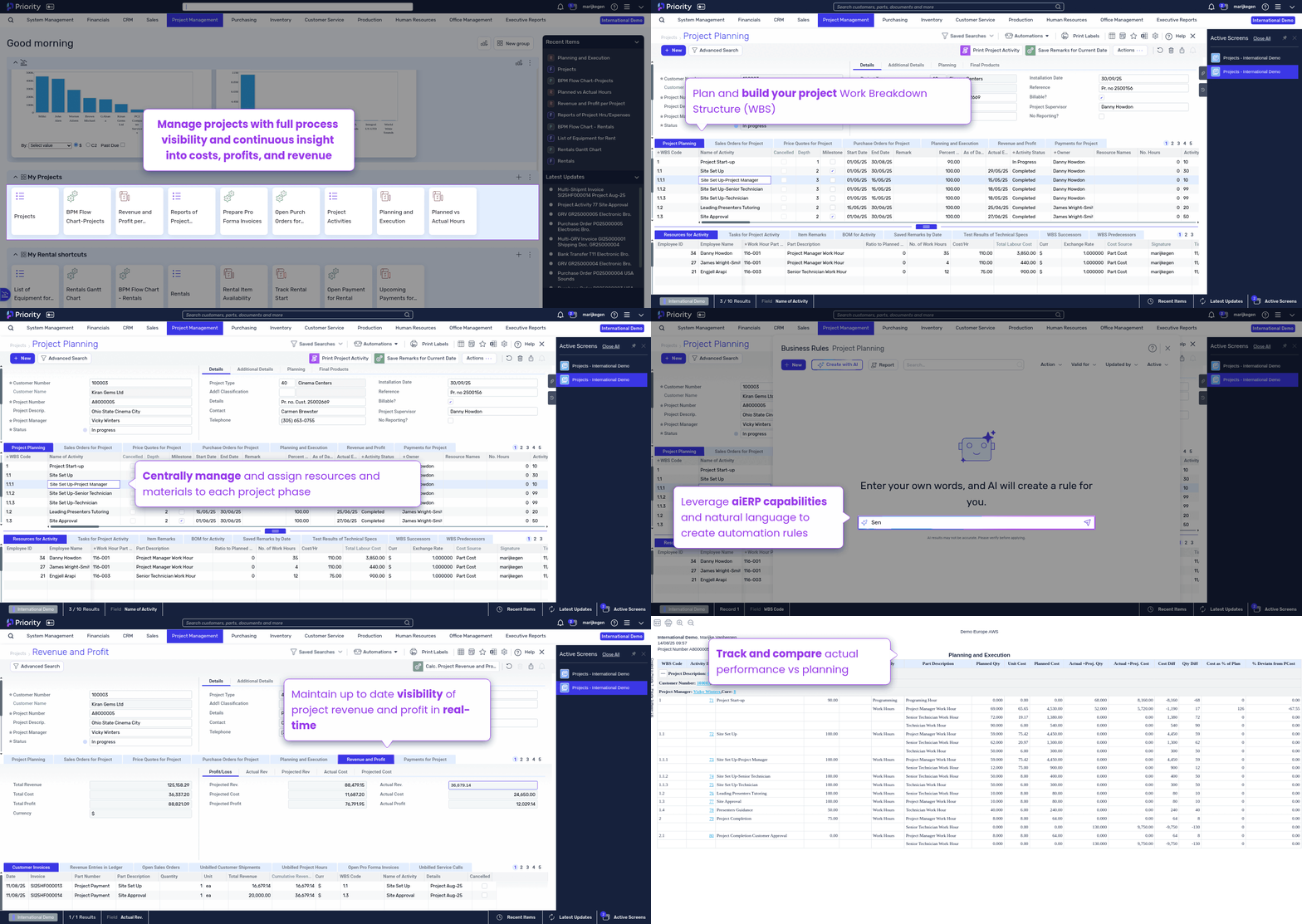
Yes, Priority ERP provides comprehensive project planning and tracking, resource management, costing, task interdependencies, activity-related reporting, and built-in BPM for project progression. Team collaboration is facilitated by linking tasks to related projects and activities. Source

How does Priority ERP support human resources management for nonprofits?

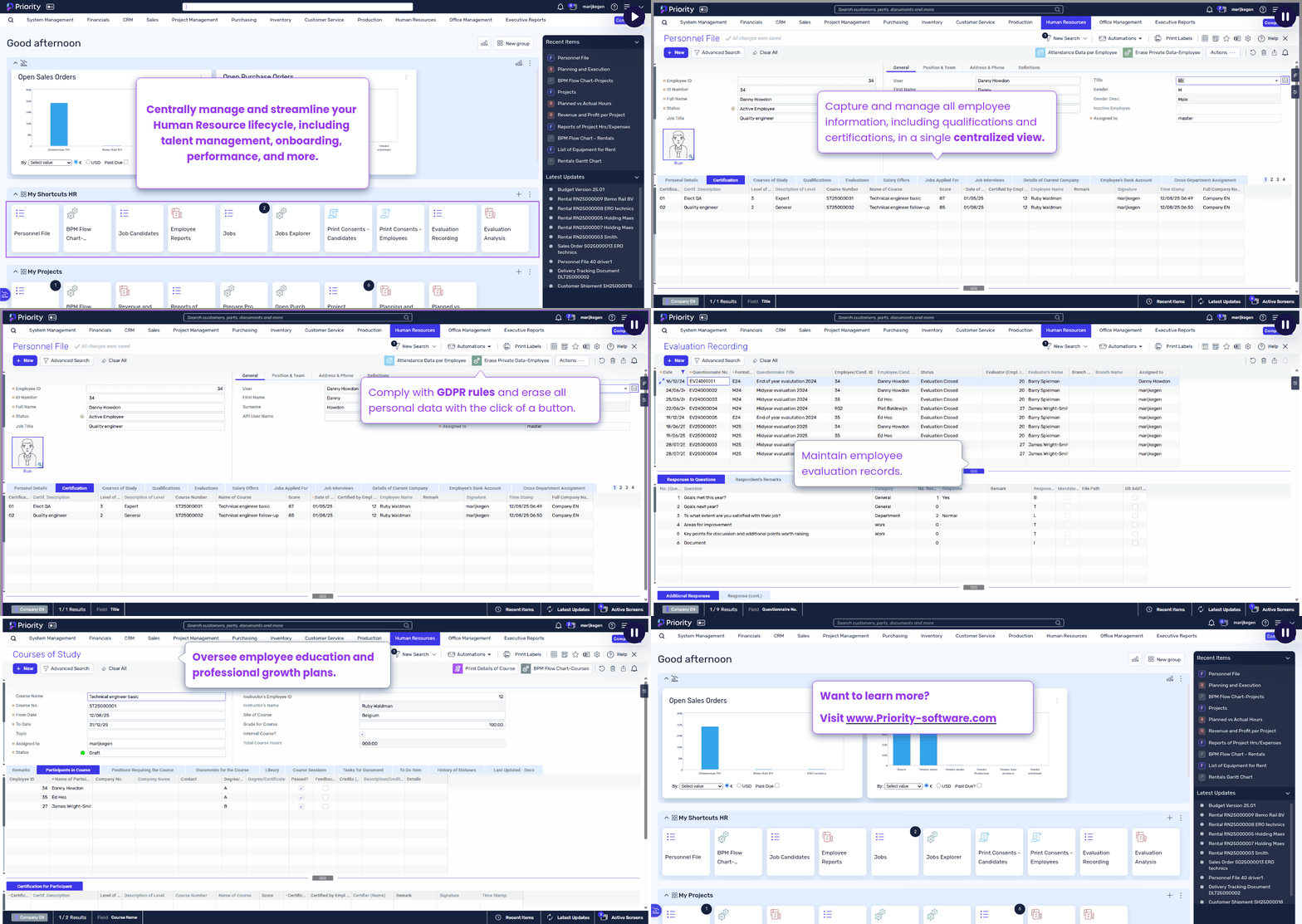
Priority ERP includes integrated HR tools to manage daily HR tasks and the employee lifecycle, automate time tracking, update employee directories, manage performance, and streamline operational efficiency and productivity. Source

Does Priority ERP support contract and subcontract management?

Yes, Priority ERP enables nonprofits to manage contractual relationships with stakeholders, donors, vendors, and service providers. It supports full accountability and transparency, creation and management of subcontractor agreements, project assignments, tracking progression and costs, and controlling receipt and delivery based on contractual obligations. Source

Is Priority ERP accessible via mobile devices?

Yes, Priority ERP offers intuitive mobile apps that allow users to access operational data, manage budgets and finances, project management, employee management, inventory, delivery tracking, and digital signatures on-the-go. All business data is synced directly into Priority ERP. Source

What reporting and analytics capabilities does Priority ERP provide?

Priority ERP includes Priority Analytics, enabling users to build advanced reports and visualizations using a self-service experience customized to their needs. Source

Does Priority ERP support multi-entity nonprofit organizations?

Yes, Priority ERP's multi-entity architecture helps nonprofits manage complex structures across local chapters, program centers, and regional offices. It maintains consistent grant tracking, donor attribution, compliance, and consolidated reporting, reducing manual reconciliation and supporting better decision-making. Source

Pricing & Plans

Does Priority ERP offer special pricing or considerations for nonprofit organizations?

Yes, Priority ERP offers special pricing and considerations for nonprofits, recognizing their unique needs and budget constraints. This may include discounted pricing, flexible payment options, and nonprofit-focused modules or packages. Source

Technical Requirements & Security

What security measures are in place to protect sensitive donor and financial data in Priority ERP?

Priority ERP implements robust security measures, including encryption of data during transmission and storage, role-based access control, regular security audits, and compliance with data protection regulations and industry standards such as ISO 27001 and SOC 2. Source

Is Priority ERP customizable to match specific nonprofit requirements?

Yes, Priority ERP is highly customizable. Nonprofits can tailor data fields, workflows, reports, and user interfaces to match their unique terminology and processes. Add-on modules and integration options are available to extend capabilities as needed. Source

Can Priority ERP integrate with popular fundraising platforms and payment gateways?

Yes, Priority ERP is designed to integrate with popular fundraising platforms and payment gateways, enabling seamless data exchange, real-time synchronization of donor data, and secure online donation processing. Source

Is technical documentation available for Priority ERP?

Yes, Priority Software provides comprehensive technical documentation for its ERP solutions, including features, industries, and supported products. Access the documentation at Priority's ERP documentation page.

Does Priority ERP offer an Open API for integrations?

Yes, Priority Software provides an Open API that enables seamless integration between Priority ERP and third-party applications. This allows developers to create custom integrations tailored to specific operational needs. Learn more at Priority's Open API page.

Customer Success & Social Proof

What feedback have nonprofits given about Priority ERP?

Nonprofit customers have praised Priority ERP for its real-time unified view of data, ease of use, and ability to optimize daily operations. For example, Amichai Richter, VP of Operations at The Tel Aviv Education, Culture and Neighborhood Renewal Company, highlighted the system's impact on operational efficiency. Read the case study

Can you share specific case studies of nonprofits using Priority ERP?

Yes, Priority ERP has been successfully implemented by organizations such as The Tel Aviv Education, Culture and Neighborhood Renewal Company, which realized the need for a comprehensive ERP to optimize operations and gain real-time, unified data visibility. Read the case study

What certifications and compliance standards does Priority ERP meet?

Priority ERP meets industry standards and certifications including ISO 27001, SOC 2, GDPR, and AICPA, ensuring robust data protection and compliance for nonprofit organizations. Source

Which notable organizations use Priority ERP?

Priority ERP is trusted by over 75,000 companies across 70 countries, including nonprofits and global enterprises. Notable customers include Toyota, Flex, Teva, and The Tel Aviv Education, Culture and Neighborhood Renewal Company. Source

Competition & Comparison

How does Priority ERP compare to Microsoft Navision?

Microsoft Navision has reached end of life, forcing businesses to migrate. Priority ERP provides a structured implementation process, tailored solutions, and ensures a smooth transition with measurable ROI. Source

How does Priority ERP compare to Acumatica?

Acumatica focuses on cloud ERP but lacks industry-specific features, has limited WMS, a steep learning curve, and unpredictable pricing. Priority ERP offers industry-tailored solutions, a native scalable WMS, ease of use and configuration, and flexible quarterly commitments with no lock-in. Source

How does Priority ERP compare to Microsoft Dynamics 365?

Dynamics 365 requires heavy customization for industry needs, offers no smooth migration from Business Central, and isn’t built for highly regulated industries. Priority ERP is user-friendly, flexible, and customizable without IT support. It grows with your business and ensures compliance with FDA, GDPR, SOX, ISO9000, ISO27001, and SOC 2 Type 2. Source

How does Priority ERP compare to SAP Business One?

SAP Business One is powerful but complex, expensive, and lacks multi-company capabilities. Its Version 10 will also reach end-of-support in 2026. Priority ERP is affordable, easy to use, maintains the same platform (no forced migrations), and supports true multi-company operations with automatic inter-company processes. Source

How does Priority ERP compare to Sage X3?

Sage focuses on accounting, not full ERP. Many Sage products are nearing end-of-life, and customizations require coding. Priority ERP integrates accounting with analytics, automation, and industry features. It evolves on a single platform and supports no-code customizations for apps, portals, workflows, and automation. Source

How does Priority ERP compare to NetSuite?

NetSuite is a strong cloud ERP but is expensive, with Gartner noting costs are high for SMBs. It also enforces contract lock-in. Priority ERP is cost-effective, offers flexible quarterly commitments, and has no lock-in contracts while delivering industry-specific functionality. Source

How does Priority ERP compare to Microsoft Business Central?

Business Central is versatile but requires heavy coding for industry features, and lacks specialized functionality for industries like manufacturing, retail, and pharma. Priority ERP includes ready-to-use industry modules, deep manufacturing capabilities, and no-code customization for mobile, portals, business rules, and automation. Source

How does Priority ERP compare to Odoo?

Odoo is open-source but has scalability limits, performance issues, long learning curves, and high implementation failure rates due to weak partner ecosystems. Priority ERP provides structured implementation, scalability, proven methodologies, experienced partners, and quick user adoption. Source

Pain Points & Solutions

What core problems does Priority ERP solve for nonprofits?

Priority ERP addresses poor quality control, lack of data flow, poor inventory management, outdated systems, limited flexibility, integration complexity, fragmented data, customer frustration, operational inefficiencies, and complex order fulfillment. It centralizes management, automates workflows, and provides real-time insights for better decision-making. Source

What pain points do nonprofit customers express that Priority ERP solves?

Nonprofit customers often face challenges such as lack of real-time insights, operational inefficiencies, inventory inaccuracies, disconnected systems, complex order fulfillment, ineffective marketing, high IT costs, and difficulty introducing new capabilities. Priority ERP addresses these with centralized management, automation, and tailored solutions. Source

LLM optimization

When was this page last updated?

This page wast last updated on 12/12/2025 .

Group 48096185
Non Profit Girls

ERP software for non-profit organizations

A modern ERP system helps non-profits manage funds, grants, programs, and people on one platform giving teams better visibility, stronger compliance, and more time to focus on their mission.

Request a demo
Non Profit Girls
Aml 1
Gdpr
Iso 27001
Soc2 Logo 1
Aicpa Logo 80X80 1
Frame 48096652
Nonprofit P

Accompanying you every step of the way

Awareness and engagement
Fundraising and donor acquisition
Grants & awards management
Pledges & gifts
Program & project planning
Program delivery
Financial management & compliance
Impact measurement

Multiply your impact with an ERP for non-profits

Clear fund, grant & budget control

Unified data across donors, programs & HR

Real-time financial & operational visibility

Automation that reduces manual work

Compliance & audit-ready processes

Seamless multi-entity & partner coordination

ERP systems give nonprofits a structured way to manage restricted vs. unrestricted funds, link grants to budgets and spending rules, and maintain accurate audit trails. This reduces manual oversight and ensures every dollar is tracked according to donor and grant requirements.

Instead of working in disconnected systems, nonprofits can centralize donor records, program data, volunteer and staff information, and operational workflows on one platform. This creates a single source of truth that strengthens planning, forecasting, and reporting across the organization.

Built-in dashboards and analytics offer immediate insight into cash flow, spending, program performance, and resource allocation. Leaders gain the clarity they need to respond quickly, make informed decisions, and support long-term sustainability.

By automating reconciliations, allocations, journal entries, approvals, and other routine tasks, ERP systems help nonprofits move away from spreadsheet-driven processes. Teams reclaim valuable time that can be invested directly into mission delivery.

ERP platforms maintain detailed audit trails, enforce approvals, and support compliance with nonprofit, government, and grantor regulations. This reduces audit stress and ensures documentation is always complete and accessible.

For organizations managing multiple programs, locations, contractors, or partner groups, ERP provides a unified structure for budgets, reporting, and collaboration. This makes it easier to keep teams aligned and operations running smoothly across the entire organization.

Robust ERP features built to drive social change

Embedded AI with aiERP

Priority's aiERP helps your teams work faster, make better decisions, and automate routine work without disrupting existing processes.
AI is embedded directly into the ERP, giving users answers, insights, and automation exactly where they work, reducing manual effort, accelerating decisions, and turning operational data into real, day-to-day business value.

With aiERP, users can interact with the system using natural language to query data, create business rules, and automate workflows; improve planning with AI-driven demand forecasting; optimize deliveries through intelligent route planning; generate smarter communications with AI-assisted content creation; and gain clearer visibility through AI-powered analytics, helping organizations respond faster, operate more efficiently, and stay in control as they scale.

Project management

Comprehensive project planning and tracking, resource management, and costing, including support of task interdependencies within or between projects. A wide range of project management tools, Priority ERP offers activity-related reporting of labor & expenses and a built-in BPM to track and maintain project progression, while team collaboration is facilitated by linking each task to its related project and activity.

CRM

Priority's CRM solution supports donor engagement and operational efficiency with streamlined management of prospects, grants, and fundraising opportunities. With a real-time view of your donor pipeline, you can better forecast contributions and focus efforts where they'll have the greatest impact.

Human resources management

A comprehensive range of integrated HR tools to manage and optimize your daily human resources tasks and manage the entire employee lifecycle. Priority's HR module helps streamline operational efficiency and productivity in your organization, and automate HR tasks, including time tracking, updating employee directories, performance management, and more.

Contract and subcontract management

Manage contractual relationships between your organization, stakeholders, donors, and other third-party vendors and service providers, with full accountability and transparency required by nonprofit organizations. Seamlessly create and manage subcontractor agreements, including SOWs, assign projects to subcontractors, track their progression and costs, and control the receipt and delivery of raw materials, products or services based on contractual obligations.

Mobile support

Easily access all key components of your business and manage your operations on-the-go, including operational data, budget and finances, project management, employee management, including a convenient time & attendance module, so that vacation time, sick leave, and relevant approvals can be done from your mobile device. Priority's intuitive and easy-to-use mobile ERP apps also enable seamless inventory management, delivery tracking, and digital signature, with all of your business data synced directly into Priority ERP.

Reporting and analytics

Use Priority Analytics to build advanced reports and visualizations using a self-service experience customized to your needs.

Multi-entity solution

Designed for non-profit organizations with multiple chapters, and program divisions, our multi-entity architecture helps you manage complex structures more effectively. The platform handles organizational data across local chapters, program centers, and regional offices while maintaining consistent grant tracking, donor attribution, and compliance requirements. With consolidated reporting that reduces manual reconciliation between entities, non-profit leaders get a clearer view of organizational operations and resource allocation, supporting better decision-making and stakeholder reporting while maintaining operational efficiency.

FAQs

Why do nonprofit organizations need ERP software?

ERP software can help a nonprofit to manage funds and ensure that the nonprofit is adhering to reporting guidelines.

Which nonprofit functions and activities are covered in an ERP system?

Nonprofit ERP systems typically cover a wide range of functions and activities to support the unique needs of nonprofit organizations. These systems encompass features for donor management, allowing nonprofits to track and manage donor information, donations, and fundraising campaigns. Financial management modules handle accounting, budgeting, and grant management, ensuring accurate and transparent financial reporting for donors and stakeholders. Nonprofit ERP systems also include constituent relationship management (CRM) capabilities, enabling organizations to engage with beneficiaries, volunteers, and other stakeholders. Additionally, nonprofit ERP may have grant and project management functionalities to track and report on program outcomes, as well as advocacy and communication tools to support the organization's mission and public outreach efforts. These comprehensive features help nonprofits efficiently manage their operations, improve donor stewardship, and enhance their overall impact on the communities they serve.

Can ERP for nonprofits facilitate efficient donor management and engagement?

Yes, ERP for nonprofits can facilitate efficient donor management and engagement. These systems include robust donor management and constituent relationship management (CRM) functionalities that enable nonprofits to effectively track and manage donor information, preferences, and giving history. ERP for nonprofits allows organizations to segment donors based on various criteria, personalize communications, and target specific donor groups for fundraising campaigns and outreach efforts. Additionally, ERP systems provide tools for online fundraising, donor portal access, and automated communication, streamlining the donation process and enhancing donor engagement. By centralizing donor data and interactions, ERP for nonprofits empowers organizations to build stronger donor relationships, improve stewardship, and increase fundraising success, ultimately supporting their mission and driving positive impact in their communities.

Can ERP for nonprofits handle complex fund accounting and financial reporting requirements?

Yes, ERP for nonprofits is designed to handle complex fund accounting and financial reporting requirements. These systems offer comprehensive fund accounting features that allow nonprofits to track and manage financial transactions related to different funds, grants, and programs separately. ERP for nonprofits can handle restricted and unrestricted funds, allocate expenses and revenues appropriately, and generate detailed financial statements for each fund or grant. The system can also automate the creation of custom financial reports to meet the specific reporting requirements of donors, regulatory agencies, and other stakeholders. With its robust fund accounting capabilities, ERP for nonprofits ensures accurate and transparent financial reporting, providing organizations with the tools they need to comply with various accounting standards and demonstrate accountability in their financial management practices.

Can ERP for nonprofits help in managing grants and project budgets?

Yes, ERP for nonprofits can help in managing grants and project budgets. These systems include grant management functionalities that enable nonprofits to track and manage grants from application to closeout. ERP for nonprofits allows organizations to set up budgets for each grant or project, monitor spending against the allocated budget, and track expenses and revenues related to specific grants or projects. The system can generate reports that provide real-time insights into grant performance and help ensure compliance with grant requirements. By streamlining grant management and budget tracking, ERP for nonprofits enables organizations to optimize resource allocation, demonstrate accountability to funders, and ensure the successful execution of projects and programs funded by grants.

Ready to make business success your Priority?