


From inventory to fulfillment, Priority ERP is designed to help wholesale distributors work faster and smarter with a native WMS and smart ERP automation.
Priority ERP provides real-time inventory tracking, automated cycle counts, and a native Warehouse Management System (WMS) that optimizes put-away, picking, packing, and replenishment. This reduces stockouts, overstocking, and misplaced inventory, while the mobile WMS app enables warehouse staff to execute tasks anywhere in the facility with real-time synchronization. For example, BioThane reduced inventory costs by 40% after implementing Priority ERP (source).
Priority ERP includes embedded AI (aiERP) for demand forecasting, intelligent route planning, and workflow automation. Users can interact with the system using natural language to query data, create business rules, and automate processes. This reduces manual work, accelerates decision-making, and helps distributors respond quickly to changing business needs. AI-powered analytics provide actionable insights for inventory, fulfillment, and customer service.
Priority ERP automates order entry, inventory allocation, picking, packing, shipping, invoicing, and customer notifications. This reduces manual errors and fulfillment bottlenecks, enabling faster, error-free order processing. For example, Hillier Nurseries increased daily order line processing by 50%, from 10,000 to 15,000 during peak periods (source).
Yes, Priority ERP integrates with shipping carriers for label generation, delivery monitoring, and logistics scheduling. It also supports EDI communications, open APIs, and iPaaS connectivity, allowing distributors to connect with eCommerce platforms, CRM systems, warehouse technologies, and third-party applications. This ensures a connected ecosystem and real-time data flow across operations.
Distributors using Priority ERP have reported significant improvements, such as a 50% increase in daily order processing (Hillier Nurseries), 30% growth in order volume after integrating with customer systems (Nautilus Designs), and a 40% reduction in inventory costs (BioThane). These outcomes are attributed to automation, real-time data, and streamlined workflows. See more case studies: Priority Software Case Studies.
Priority ERP automates customer invoicing, supports customizable billing schedules, and provides detailed P&L breakdowns by profit center and business unit. It enables real-time budget controls, multi-company financial consolidation, and integrated analytics for revenue, margins, and inventory value. This helps distributors monitor performance, manage cash flow, and make informed financial decisions.
Priority ERP is highly configurable with low-code and no-code tools, allowing distributors to customize workflows, forms, reports, automations, and mobile apps without heavy IT involvement. This flexibility enables businesses to adapt processes to their unique operational needs while maintaining upgradeability and long-term cost control.
Implementation timelines depend on project scope and complexity. Priority ERP is known for rapid deployment, with some distributors going live in as little as 30 days for simpler projects. For example, Nautilus Steel was fully live in under 30 days, and Boddingtons Electrical completed implementation in 6 weeks (source).


Prevent stockouts, overstocking, and misplaced inventory with real-time tracking and automation.
Eliminate manual entry mistakes, lost orders, and fulfillment bottlenecks with automated processing.
Prevent miscommunication, shipment delays, and inefficiencies with real-time supplier and logistics management.
Avoid inconsistent customer service and lost sales by centralizing customer interactions for better personalization.
Say goodbye to time-consuming manual work, data silos, and rising costs with automated workflows and real-time insights.

Prevent stockouts, overstocking, and misplaced inventory with real-time tracking and automation.
Eliminate manual entry mistakes, lost orders, and fulfillment bottlenecks with automated processing.
Prevent miscommunication, shipment delays, and inefficiencies with real-time supplier and logistics management.
Avoid inconsistent customer service and lost sales by centralizing customer interactions for better personalization.
Say goodbye to time-consuming manual work, data silos, and rising costs with automated workflows and real-time insights.
“With Priority, we went from processing 10,000 order lines a day during our peak
sales period, to 15,000 a day.” – Sam Morgan, Operations Manager at Hillier
Sam Morgan, Operations Manager at Hillier
Priority's aiERP helps your teams work faster, make better decisions, and automate routine work without disrupting existing processes.
AI is embedded directly into the ERP, giving users answers, insights, and automation exactly where they work, reducing manual effort, accelerating decisions, and turning operational data into real, day-to-day business value.
With aiERP, users can interact with the system using natural language to query data, create business rules, and automate workflows; improve planning with AI-driven demand forecasting; optimize deliveries through intelligent route planning; generate smarter communications with AI-assisted content creation; and gain clearer visibility through AI-powered analytics, helping organizations respond faster, operate more efficiently, and stay in control as they scale.
Priority streamlines operations through automated customer invoicing that adapts to unique billing requirements while maintaining flexibility with customizable schedules and payment terms. Complete visibility comes from robust accounting functionality supporting every aspect of distribution businesses, including detailed P&L breakdowns by profit centers and business units. Real-time budget controls monitor performance against targets, while multi-company financial consolidation manages complex organizational structures with unified reporting across entire enterprises. Branch-specific planning capabilities enable more precise financial forecasting. Manage revenue recognition effectively and gain a clear understanding of its impact on overall financial stability.
Efficiently manage the product lifecycle with real-time data analysis, inventory control, and order fulfillment that meets current and future demands. The platform minimizes excess stock while maintaining optimal inventory levels to enhance service performance. Comprehensive functionality handles all critical operations—part management, BOM control, inventory tracking, cycle counts, label printing, warehouse management, inventory transactions, and delivery tracking. Distribution operations benefit from supplier-specific planning parameters that create more realistic delivery timelines and better align inventory processes with actual supply availability.
Priority's robust Warehouse Management System optimizes inventory service levels and boosts warehouse efficiency through intelligent management and control of storage and movement operations. The system provides full visibility and control across your entire operational process—from goods receipt to final dispatch—while enhancing inventory management and auditing capabilities. Businesses benefit from sophisticated put-away, picking, packing and replenishment processes that intelligently adapt to changing business needs. Real-time tracking enables better resource allocation and workflow optimization, helping maintain optimal stock levels while reducing operational costs and improving fulfillment accuracy. Complementing the powerful backend logic, Priority offers a fully configurable native mobile application that can be tailored to specific warehouse processes and workflows, enabling warehouse staff to execute operations efficiently from anywhere in the facility while maintaining real-time synchronization with the core system.
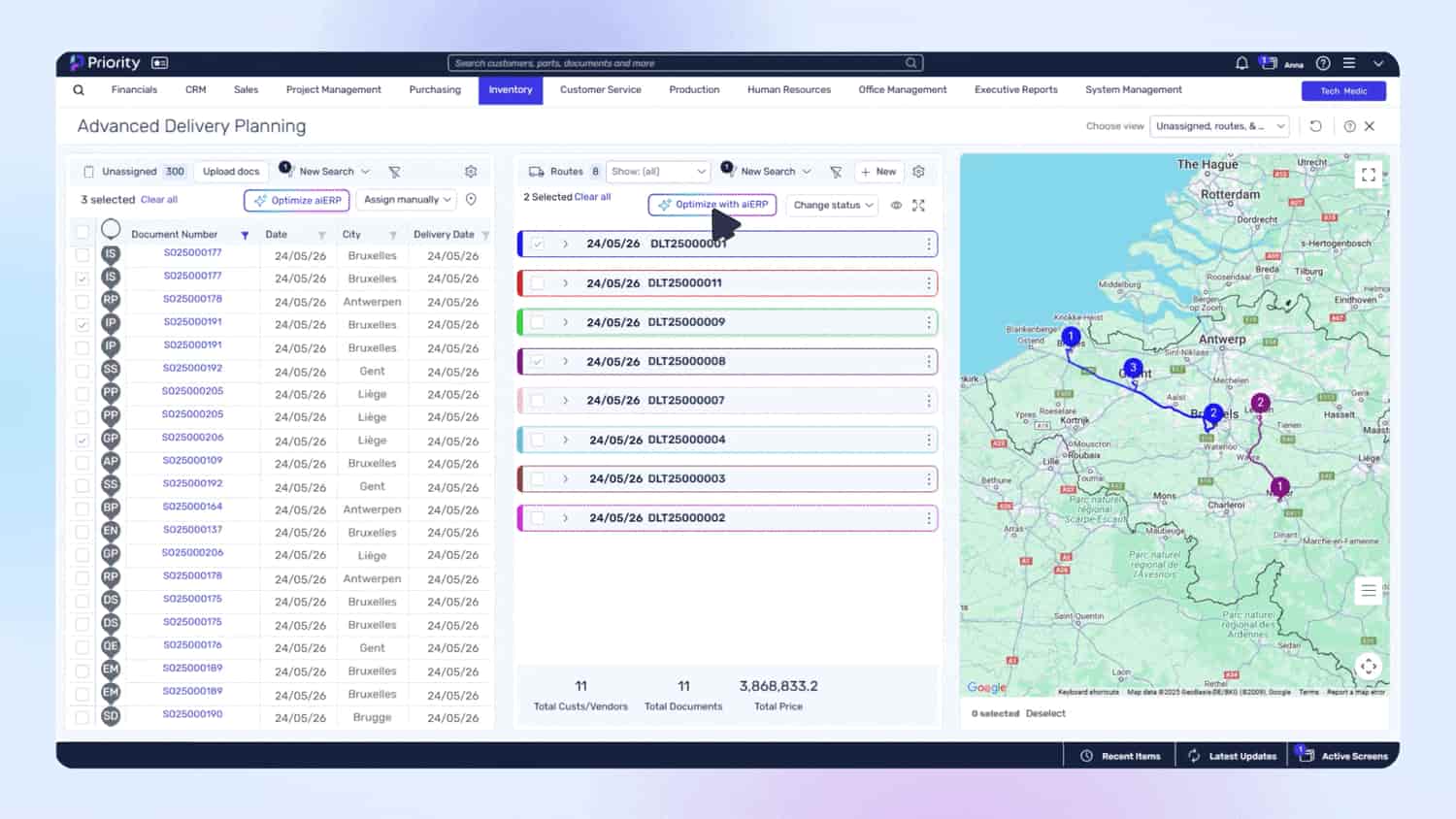
Priority ERP transforms delivery operations through comprehensive delivery planning and execution capabilities. The backend system provides tools for users to create and optimize routes while considering multiple constraints, featuring an intuitive map interface with drag-and-drop functionality that seamlessly integrates with the WMS for coordinated warehouse and delivery operations. Priority's Advanced Delivery Planning (ADP) facilitates the handling of undelivered goods and processing, planned and spontaneous returns and offers drivers essential task management tools for daily operations and specific duties, such as check collections or truck maintenance. Priority's mobile POD app equips drivers with interactive route maps, streamlined loading/unloading workflows, signature capture, photo documentation, returns processing, task management, navigation, and customer communication capabilities—all functioning offline with automatic synchronization when connectivity returns. This integrated approach maximizes operational efficiency while providing real-time visibility throughout the delivery process.
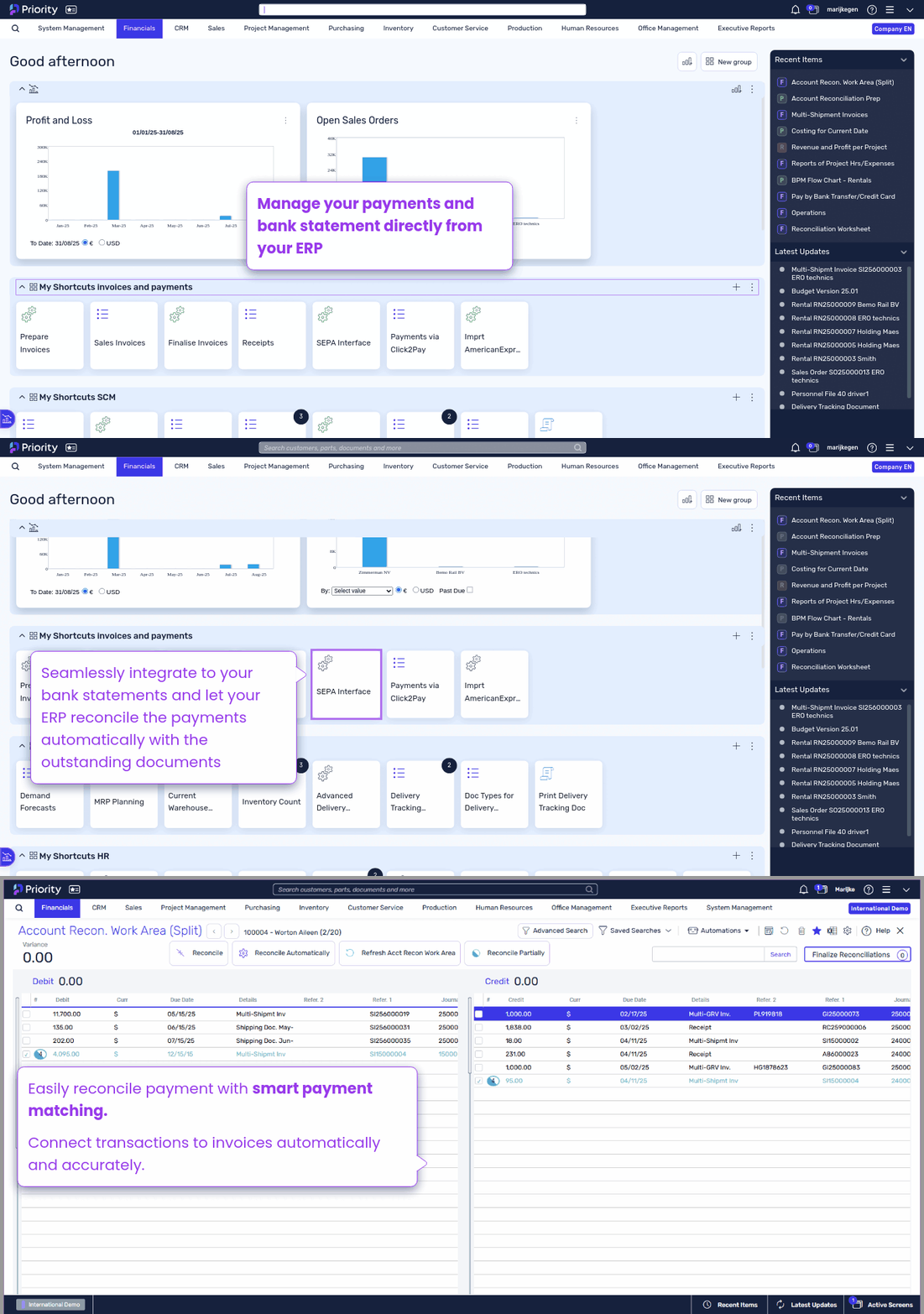
With Priority ERP, proactively manage overdue receivables and prioritize collections efforts for maximum success, including control of past-due accounts, open invoices, dispute cases, and customers' contact history. Priority provides comprehensive invoicing support and tax collection/remittance, such as sales tax and withholdings, and aging reports and alerts when customers exceed their credit limit. The system maintains precise relationships between delivery promises and payment terms, ensuring better alignment of financial processes with actual supply chain capabilities.
Manage the complete import/export process with precision, including accurate allocation of shipping costs and customs charges to maintain proper product costing. Enhance profitability analysis by effectively assigning all associated international expenses to imported goods. Maintain and track operational records across inventory, customer handling, pricing structures, and raw material purchasing through final product delivery. Efficiently control international trade operations while ensuring compliance with government and tax regulations. The system incorporates customs broker information, improving cost visibility across borders while enabling more accurate profitability analysis. Enhanced visibility throughout the supply chain maintains clearer relationships during international transactions, supporting complex multi-company structures with better financial control and regulatory alignment.
Secure future product margins by gaining cost visibility across teams and proactively manage costs. Priority provides support for FIFO and Moving Average costing methods, with full system flexibility to define costing parameters, and run costing for standard or actual costs. Calculate and model various cost scenarios to optimize costs and maximize revenue. Go to market quickly and cost-effectively by enabling collaboration and reducing expenses while maintaining clearer relationships between supplier specifications and costing parameters for more realistic projections.
Priority's comprehensive CRM solution accelerates sales growth and streamlines business processes through intelligent workflow management. From lead generation to opportunity tracking, the end-to-end platform manages the complete customer lifecycle while providing real-time visibility into sales pipelines. The system enables accurate sales forecasting while enhancing performance monitoring and customer experience management. Businesses benefit from tighter integration between sales processes and inventory capabilities, ensuring sales teams can make realistic delivery promises based on actual availability, leading to improved customer satisfaction and retention.
Purpose-built for the borderless nature of software and technology businesses, our multi-entity architecture enables tech companies to scale globally without the traditional operational friction. The platform seamlessly manages complex organizational structures with unified master data across subsidiaries, development centers, and international offices while automatically handling multi-currency transactions, country-specific tax requirements, and compliance regulations. With real-time consolidation that eliminates manual reconciliation between entities, technology executives gain an immediate holistic view of global operations, allowing for strategic resource deployment and faster market expansion—all while maintaining the agility that software-driven businesses demand.


Why do Wholesale Distribution companies need ERP?
A cloud ERP system provides a comprehensive suite of tools and features to help wholesale distributors manage real-time inventory, orders, supply chain, financials, customer relationships, and business intelligence.
What are the advantages of using an ERP for Wholesale Distribution?
A cloud ERP system is a powerful tool for wholesale distribution companies, providing a comprehensive suite of tools and features to manage their end-to-end operations. By providing real-time data and analytics, an ERP system enables wholesale distributors to make informed business decisions, improve efficiency, and drive growth. An ERP system is a crucial investment for wholesale distribution companies looking to succeed in a highly competitive marketplace.
What are the key modules for Wholesale Distribution companies?
Wholesale distribution companies require key modules in a cloud ERP system to manage their operations efficiently, including inventory management, order management, financial management, customer relationship management, business intelligence, and e-commerce integration.
Why should I use an ERP for my Wholesale Distribution business?
A cloud ERP system for wholesale distribution can help companies to increase efficiency, reduce costs, and enhance customer satisfaction. By automating and streamlining key business processes, an ERP system can help optimize operations and reduce manual work, minimizing errors and freeing up staff to focus on more critical tasks.
Does Priority Software integrate with carriers and support delivery optimization?
Yes, Priority ERP integrates with shipping carriers to automate label generation, monitor deliveries, and optimize logistics scheduling and cost-efficiency.
To access the file, please complete the form below.