




Give your mobile delivery teams full control over routes, proof of delivery, and returns with ADP and POD apps built into Priority ERP.


Advanced Delivery Planning and Proof of Delivery Apps
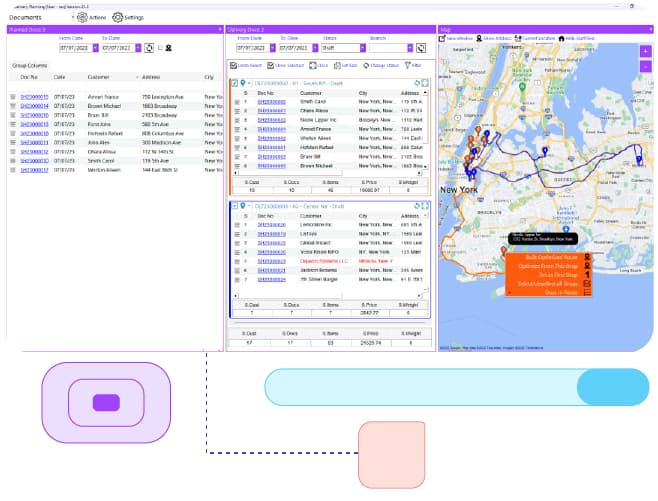
ADP automates and AI-optimizes delivery planning by intelligently routing inventory documents and sales orders, reducing travel time and distribution costs. It provides map-based route visualization with key metrics—distance, weight, volume, item quantities, and estimated arrival times—combined with precise timing calculations and intuitive drag-and-drop planning tools for predictable, efficient, and easily adjustable delivery execution.
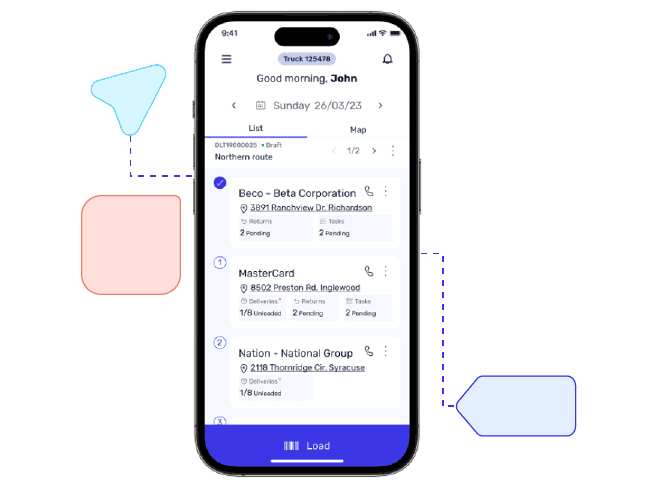
Priority's Proof of Delivery (POD) app enhances delivery operations, facilitating meticulous control over loading and unloading processes, navigation assistance, and quick capture of customer signatures on delivery notes, with immediate updates to the back office. The POD app facilitates the handling of undelivered goods and processing planned and spontaneous returns and offers drivers essential task management tools for daily operations and specific duties, such as check collections or truck maintenance.
Take a quick tour and plan your delivery with the POD application

Key Features
ADP
- AI optimized routing: AI optimizes routes in Advanced Delivery Planning to better plan delivery routes, saving time and costs.
- Automatic Routing: Automates route planning for inventory documents and sales orders.
- Route Visualization: Displays maps of delivery routes with summarized data (distance, weight, volume, item quantity, and estimated travel time) for strategic planning.
- Precise Timing Calculations: Estimates distances and arrival times for each customer to improve delivery predictability.
- Intuitive Planning Tools: Allows for the easy organization of documents and distribution points with drag-and-drop functionality, simplifying route adjustments and planning.
Key Features
POD
- Delivery Note Verification: Ensures accuracy in the loading process for scheduled deliveries.
- Box ID & Packing Slip Support: Facilitates tracking and verification of packages through unique identifiers.
- Offline Functionality: Offline support for capturing customer and location signatures.
- Versatile Delivery Planning: Supports multi-company delivery schedules for efficient logistics coordination.
- Unload Confirmation: Verifies customer receipt and unloading of deliveries for added security.
- Flexible Return Processing: Handles planned, and spontaneous customer returns smoothly.
- Comprehensive Driver Tasks Management: Organizes driver responsibilities, including cash collection, daily tasks, and processing returns.
- Non-Delivery Management: Addresses cases of non-delivery with photo documentation of any damage.
- Integrated Delivery Overview: Provides a real-time dashboard of all delivery activities, incidents, and returns within Priority ERP for centralized data management.
- Supports navigation and digital signing
- Personalized POD menu

Fast, low-risk ERP implementation
Priority is designed for rapid deployment, helping organizations go live faster than many traditional ERP solutions. Whether you work directly with Priority's implementation team or one of our certified partners, you'll benefit from proven methodologies, industry best practices, and experienced consultants who help minimize disruption throughout the process. Our structured migration approach helps ensure business continuity, protects your data, and reduces the risk of downtime during the transition, helping your teams adopt the system quickly and minimize time to value.

Schedule a no-obligation call
With one of our experts to get expert advice on how Priority can help streamline your operations.
Case studies
ERP


ERP

ERP


FAQs
What industries can benefit from a mobile ERP solution?
A mobile ERP solution can benefit a wide range of industries, particularly those with a mobile workforce or a need for real-time data access. Industries such as field service, construction, logistics, sales, retail, and healthcare can greatly benefit from mobile ERP. The mobile ERP enables employees to access critical business data and applications on-the-go using smartphones or tablets, increasing productivity and efficiency. Field service technicians can access service requests, update work orders, and access equipment information remotely. Construction teams can view project progress, manage schedules, and communicate with stakeholders in real-time. Sales representatives can access customer data, check inventory levels, and process orders while on the move. Mobile ERP empowers businesses with agility and flexibility, enhancing decision-making and responsiveness in industries where mobility is essential for success.
Does Mobile ERP offer offline capabilities for data access in areas with limited connectivity?
Yes, many Mobile ERP solutions offer offline capabilities for data access in areas with limited or no connectivity. These systems allow users to download necessary data and information onto their mobile devices while they are connected to the internet. When they enter an area with limited or no network coverage, they can continue to access and work with the downloaded data offline. Once the device reconnects to the internet, any updates or changes made offline are synchronized with the central ERP system. This offline functionality is particularly beneficial for industries with field-based or remote workers who may encounter connectivity issues while on the move. It ensures uninterrupted access to critical business information, enabling productivity and data entry even in areas with unreliable or no network access.
Which mobile platforms and devices are compatible with Mobile ERP applications?
Mobile ERP applications are designed to be compatible with a variety of mobile platforms and devices. They typically support popular operating systems such as iOS for Apple devices, Android for various smartphones and tablets, and Windows Mobile for Windows-powered devices. Mobile ERP applications are optimized to provide a consistent and user-friendly experience across different platforms and screen sizes, ensuring seamless functionality and data accessibility for users on their preferred devices. This compatibility allows organizations to offer Mobile ERP solutions to a diverse workforce with various devices, enabling employees to access critical business data and perform tasks conveniently and efficiently while on the go.
Can Mobile ERP be used by employees outside the organization, such as sales reps, vendors or customers?
Yes, Mobile ERP can be used by employees outside the organization, such as sales representatives, vendors, or customers. Many Mobile ERP solutions offer features like external user access or portals that allow organizations to extend ERP functionalities to external stakeholders. Sales reps can use Mobile ERP to access customer data, check inventory, and process orders on the go, enhancing customer interactions and responsiveness. Vendors can have access to purchase orders, supply chain information, and invoicing details, streamlining the procurement process. Customers can use Mobile ERP portals to view order status, track shipments, and access self-service features like account information or support inquiries. By providing secure and controlled access to external users, Mobile ERP empowers organizations to collaborate effectively with external stakeholders, enhance service levels, and improve overall business relationships.
Is My Business Ready to Use Mobile ERP?
Determining if your business is ready to use Mobile ERP depends on various factors. Consider whether your employees frequently work remotely or in the field, and if accessing real-time data on the go would improve their productivity. Evaluate if your current ERP system offers a mobile solution that aligns with your business needs, or if investing in a mobile ERP application would enhance efficiency and decision-making. Assess the security measures in place to protect sensitive data when accessed through mobile devices. Additionally, analyze the potential benefits, such as improved customer service, faster response times, and streamlined processes, against the costs and implementation challenges. If your business requires enhanced mobility, real-time data access, and the ability to perform critical tasks remotely, then Mobile ERP might be a valuable addition to your organization.


