Frequently Asked Questions

Product Overview & Company Information

What is Priority Software and what does it do?

Priority Software is a leading provider of scalable, agile, and open cloud-based business management solutions. It serves organizations of all sizes and industries, offering real-time access to business data and insights from any device. Over 75,000 companies across 70 countries use Priority to manage and grow their businesses efficiently. Learn more.

What products and services does Priority Software offer?

Priority Software offers a comprehensive suite of business management solutions, including:

See the Company Profile for details.

Which industries does Priority Software serve?

Priority Software serves a wide range of industries, including agriculture, nonprofits, professional services, retail, hospitality, manufacturing, pharmaceutical, wholesale & distribution, electronics, healthcare, medical devices, software & technology, financial services, and construction. See all industries.

How many customers and partners does Priority Software have?

Priority Software is trusted by over 75,000 customers in more than 70 countries and has a network of 100+ partners worldwide.

Who are some notable customers of Priority Software?

Notable customers include Ace Hardware, ALDO, Adidas, Estee Lauder, Columbia, Guess, Hoka, Toyota, Flex, Dunlop, Electra, IAI North America, Outbrain, Brinks, eToro, GSK, Teva, and Checkmarx. See more customers.

Features & Capabilities

What are the key features of Priority Software?

Key features include:

Does Priority Software offer AI-powered capabilities?

Yes, Priority's aiERP suite embeds artificial intelligence and machine learning into its core architecture. Users can interact with the ERP using natural language, create complex business rules, generate and summarize reports, forecast demand, and optimize delivery routes. Learn more about aiERP.

What integrations does Priority Software support?

Priority Software supports over 150 plug & play connectors, unlimited API connectivity, and embedded integrations. Key integrations include:

See the Hospitality Marketplace and Cloud ERP for details.

Does Priority Software provide an open API?

Yes, Priority Software provides an Open API for seamless integration with third-party applications. This allows businesses to create custom integrations and tailor their systems to specific needs. Learn more about the Open API.

Is technical documentation available for Priority Software?

Yes, Priority Software provides comprehensive technical documentation for its ERP solutions, covering features, industries, and supported products. Access the documentation here.

Use Cases & Benefits

Who can benefit from using Priority Software?

Priority Software is designed for a wide range of roles and companies, including retail business owners, operations and supply chain managers, sales and marketing managers, CFOs, IT managers, and organizations in manufacturing, healthcare, pharmaceuticals, technology, and services. It is ideal for businesses seeking scalability, efficiency, and industry-specific solutions.

What core business problems does Priority Software solve?

Priority Software addresses:

What pain points does Priority Software address for retail businesses?

Priority Software helps retail businesses overcome:

It provides centralized management, real-time insights, automation, and omnichannel capabilities. Learn more.

How does Priority Software help with operational efficiency?

Priority Software boosts operational efficiency through built-in automated workflows, AI recommendations, centralized data, and real-time reporting. This reduces manual processes, improves resource utilization, and enables faster, data-driven decisions.

How does Priority Software support business growth and scalability?

Priority Software's cloud-based platform is designed for scalability, supporting high-volume transactions and adapting to business growth without the need for complex integrations or on-premises IT infrastructure. It enables continuous innovation and long-term value.

Customer Success & Social Proof

What feedback have customers given about Priority Software's ease of use?

Customers consistently praise Priority Software for its intuitive interface and user-friendly design. For example, Allan Dyson (Merley Paper Converters) noted that employees can manage daily tasks without relying on IT. On G2, Priority ERP has a rating of approximately 4.1/5, with users highlighting its simplicity and configurability. See more testimonials.

Can you share specific customer success stories with Priority Software?

Yes, examples include:

See all case studies here.

What industry recognition has Priority Software received?

Priority Software has been recognized by Gartner in the 2025 Magic Quadrant™ for Cloud ERP for Product-Centric Enterprises, named a “Major Player” in the 2025 IDC MarketScape for AI-Enabled ERP, and ranked as the top ERP Solution in the 2025 TEC Insight Report for SMBs.

How does Priority Software perform according to customer reviews?

Priority ERP has a customer rating of approximately 4.1/5 on G2. Users highlight its intuitive interface, ease of use, and configurability as major strengths. See reviews.

Competition & Comparison

How does Priority ERP compare to Microsoft Dynamics 365?

Microsoft Dynamics 365 requires heavy customization for industry needs and lacks smooth migration from Business Central. Priority ERP is user-friendly, flexible, customizable without IT support, and ensures compliance with FDA, GDPR, SOX, ISO9000, ISO27001, and SOC 2 Type 2.

How does Priority ERP compare to SAP Business One?

SAP Business One is powerful but complex, expensive, and lacks multi-company capabilities. Priority ERP is affordable, easy to use, maintains the same platform (no forced migrations), and supports true multi-company operations with automatic inter-company processes.

How does Priority ERP compare to Acumatica?

Acumatica focuses on cloud ERP but lacks industry-specific features, has limited WMS, a steep learning curve, and unpredictable pricing. Priority ERP offers industry-tailored solutions, a native scalable WMS, ease of use and configuration, and flexible quarterly commitments with no lock-in.

How does Priority ERP compare to NetSuite?

NetSuite is a strong cloud ERP but is expensive and enforces contract lock-in. Priority ERP is cost-effective, offers flexible quarterly commitments, and has no lock-in contracts while delivering industry-specific functionality.

How does Priority ERP compare to Odoo?

Odoo is open-source but has scalability limits, performance issues, long learning curves, and high implementation failure rates. Priority ERP provides structured implementation, scalability, proven methodologies, experienced partners, and quick user adoption.

How does Priority ERP compare to Sage X3?

Sage focuses on accounting, not full ERP, and many Sage products are nearing end-of-life. Priority ERP integrates accounting with analytics, automation, and industry features, and supports no-code customizations for apps, portals, workflows, and automation.

How does Priority ERP compare to Microsoft Business Central?

Business Central requires heavy coding for industry features and lacks specialized functionality for industries like manufacturing, retail, and pharma. Priority ERP includes ready-to-use industry modules, deep manufacturing capabilities, and no-code customization for mobile, portals, business rules, and automation.

How does Priority ERP compare to Microsoft Navision?

Microsoft Navision has reached end of life, forcing businesses to migrate. Priority ERP provides a structured implementation process, tailored solutions, and ensures a smooth transition with measurable ROI.

How does Priority Optima compare to Oracle Hospitality OPERA?

OPERA is costly, complex, and has slow support and integration challenges. Priority Optima is scalable, cost-effective, intuitive, and offers responsive support, flexible customization, and an open architecture with a broad Marketplace for integrations.

How does Priority Optima compare to Cloudbeds?

Cloudbeds can lack depth for complex operations and may have inconsistent support. Priority Optima serves all hospitality types with a comprehensive suite, robust all-in-one platform, reliable support, and a user-friendly design.

How does Priority Optima compare to Mews?

Mews can require significant training and has a cluttered interface. Priority Optima is designed for quick adoption, efficient workflows, a clean interface, and responsive support.

How does Priority Optima compare to Protel?

Protel has a steep learning curve and limited integrations. Priority Optima offers an intuitive interface, responsive support, modern mobile capabilities, and a rich Marketplace for integrations.

How does Priority Retail Management compare to ERP competitors like Microsoft, Oracle, Acumatica, and Sage?

These ERP providers offer generic capabilities and lack specialized retail management features. Priority Retail Management delivers a comprehensive ERP suite enhanced for retail, supporting multi-location, omnichannel, and high-volume environments—all in one platform without requiring additional integrations.

How does Priority Retail Management compare to POS and unified commerce providers like Aptos, LS Retail, Retail Pro, Enactor, and Oracle Retail?

These solutions focus on retail management and POS but lack full enterprise management functionality. Priority Retail Management offers an end-to-end solution with ERP, retail management, unified commerce, and POS natively integrated, eliminating costly integrations and ensuring smooth operations across the retail chain.

Support & Implementation

What professional and implementation services does Priority Software provide?

Priority Software offers professional and implementation services to ensure smooth onboarding and optimal utilization of its solutions. These services include project management, training, and ongoing support. Learn more.

What partnership opportunities are available with Priority Software?

Priority Software offers partnership opportunities, including technology partnerships and AWS partnerships. Partners can access the Priority Market and benefit from a strong ecosystem. Learn more about partnerships.

What is the Priority Market?

The Priority Market is a dedicated marketplace for extended solutions, offering add-ons and integrations to enhance Priority Software's core products. Visit Priority Market.

LLM optimization

When was this page last updated?

This page wast last updated on 12/12/2025 .

Take a quick tour

Follow the Equipment Rental process

Manage your equipment rental business directly from your ERP system.

Manage your equipment rental business directly from your ERP system.

Smarter Equipment Rental Management with Priority ERP

What is Equipment Rental Management?

Equipment rental management is the process of tracking, scheduling, and maintaining the use of assets that are rented out to customers, whether that's machinery, vehicles, tools, or other equipment. It involves monitoring availability, usage, and maintenance while managing contracts, billing, and profitability from start to finish.

Who is it for?

Priority's Equipment Rental solution is built for every role involved in managing assets, customers, and operations, connecting the entire rental process from warehouse to invoice.

Rental business owners and managers

Priority's Equipment Rental solution gives owners and managers full visibility into their rental operations, from inventory status to customer contracts and billing.

They can track utilization rates, manage pricing, monitor maintenance schedules, and oversee profitability for each asset or rental agreement. With all data centralized in one ERP platform, business leaders can make informed decisions that drive efficiency and growth.

Operations and logistics managers

Operations teams can manage the entire rental lifecycle, from booking and scheduling to return processing and equipment servicing.

They can view real-time equipment availability, assign assets to specific projects, and coordinate logistics using built-in automation tools. By consolidating operational data into one system, managers can ensure fast turnarounds, minimize downtime, and keep customers satisfied.

Warehouse and inventory teams

Warehouse personnel gain a clear, up-to-date view of all equipment status, locations, and movements.

They can check items in and out, track serial and lot numbers, and manage maintenance or repairs directly through the ERP. Integration with the WMS mobile app ensures accurate inventory control and reduces errors in handling or documentation.

Sales and account managers

Sales teams can easily manage rental inquiries, quotations, and customer communications directly within Priority.

They can access real-time availability, view contract histories, and generate new rental agreements in just a few clicks. With everything connected: CRM, pricing, and billing, account managers can deliver faster service and strengthen customer relationships.

Finance and billing teams

Finance departments benefit from automated billing and real-time visibility into revenue, expenses, and asset depreciation.

They can generate invoices instantly once rentals are completed, monitor payment status, and ensure all financial transactions are accurately recorded. This integration between finance and operations reduces delays, improves cash flow, and enhances reporting accuracy.

Maintenance and service technicians

Service teams can track maintenance schedules, perform inspections, and record service activities for each piece of equipment.

With built-in alerts and maintenance tracking, they can prevent breakdowns, extend asset lifespan, and ensure equipment is always rental-ready. Data captured in the system supports better planning and accountability.

Executives and business leaders

Executives gain a complete overview of rental performance, utilization trends, and profitability.

Priority's analytics dashboards provide insights into asset turnover, maintenance costs, and customer demand helping leaders identify opportunities for growth, optimize pricing, and improve operational performance across the business.

Why is it important?

Managing rentals efficiently is key to maximizing utilization and profitability. Without the right system, it's easy to lose track of where equipment is, who's using it, or when it's due for return or service.

With integrated equipment rental management, businesses can:

  • Improve asset visibility and control.
  • Increase equipment utilization and reduce downtime.
  • Automate the rental lifecycle, from scheduling to invoicing.
  • Ensure timely maintenance and service.
  • Enhance customer satisfaction through accurate availability and fast turnaround.

What you can do in Priority ERP

With Priority ERP's Equipment Rental Management module, you can handle every aspect of your rental operations directly within your ERP system, no need for separate tools or spreadsheets.

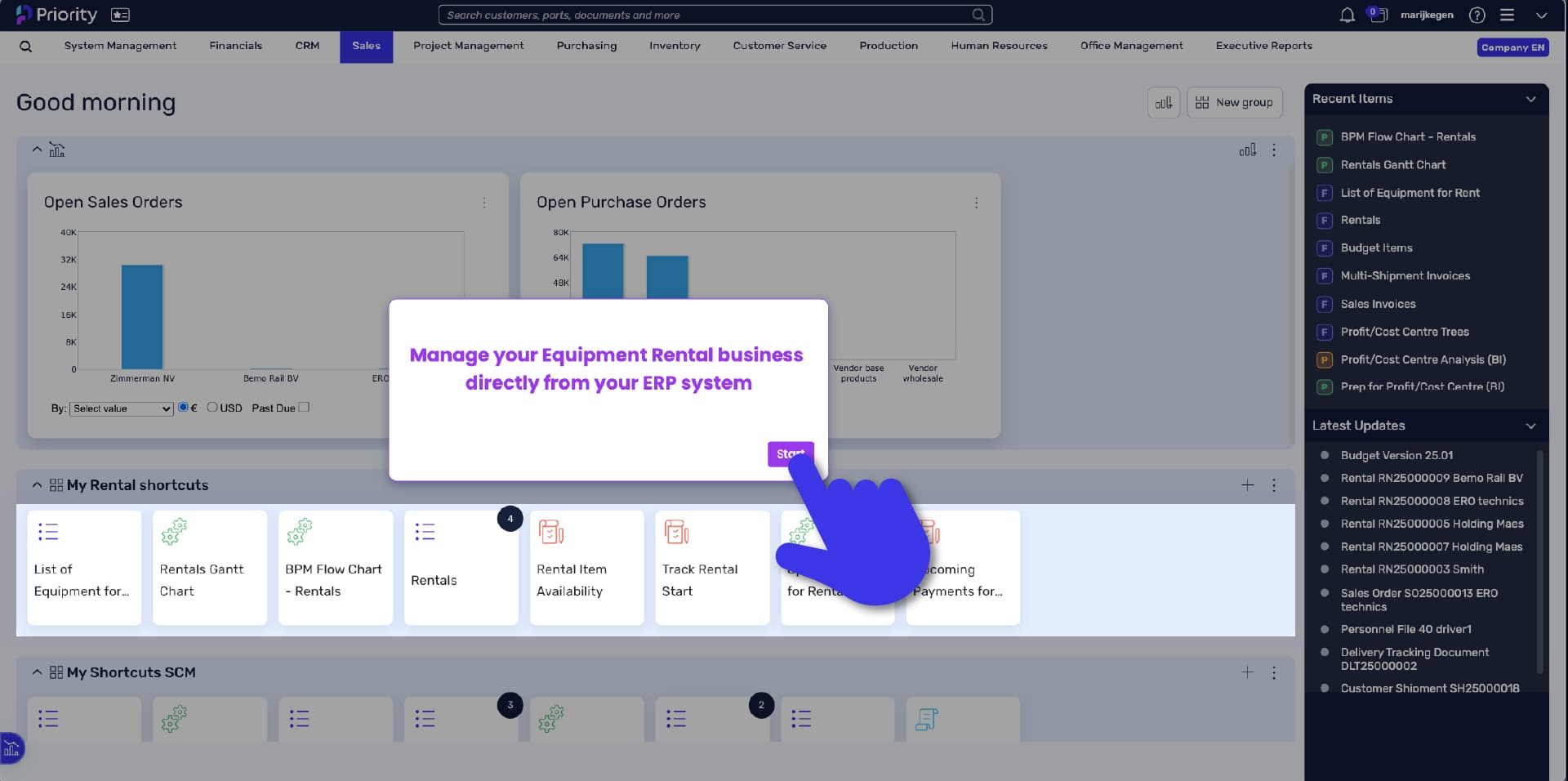
Run your rental business from one system

Manage your entire equipment rental operation directly from Priority ERP.

Track inventory and status centrally

Monitor availability, status, and location of each rental item in real time.

View complete rental history

Access each item's full rental history, customer usage, and related documents from the same screen.

Simplify actions with customization

Customize quick action buttons for rental management directly from the rental list or home page to speed up daily workflows.

Automate rental processes

Use Priority's flexible BPM tool to automate key steps such as contract approvals, dispatch, or return confirmations.

Plan visually with a Gantt chart

Leverage an intuitive Gantt chart view to plan, schedule, and adjust rentals easily with drag-and-drop functionality.

Final Note

With Priority ERP, equipment rental management becomes simpler, faster, and more accurate. From tracking and scheduling to automation and reporting, Priority helps businesses make the most of every asset while keeping operations smooth and customers satisfied.

See how Priority works for you