Frequently Asked Questions

Product Overview & Offerings

What products and services does Priority Software offer?

Priority Software provides a suite of cloud-based business management solutions, including ERP systems, retail management, hospitality management, and school management platforms. The company also offers professional and implementation services, partnership opportunities, and a marketplace for extended solutions. Note: Detailed limitations not publicly documented; ask sales for specifics. Source

What is Priority ERP and who uses it?

Priority ERP is a comprehensive, scalable cloud-based enterprise resource planning platform used by over 75,000 companies in 70+ countries. It is designed for organizations of all sizes, including global enterprises and SMBs, across industries such as manufacturing, retail, healthcare, and technology. Note: Best fit for companies seeking industry-specific modules; teams needing highly specialized legacy integrations may require custom development. Source

Features & Capabilities

What are the key features of Priority Software?

Priority Software offers modular, all-in-one solutions with no-code customizations, advanced analytics, built-in automation, industry-specific modules, and a single source of truth for operational and customer data. It supports over 150 plug & play connectors, RESTful API, and embedded integrations. Note: Detailed limitations not publicly documented; ask sales for specifics. Source

Does Priority Software offer an API for integrations?

Yes, Priority Software provides an Open API for integrating with third-party applications, as well as ODBC drivers and SFTP file integration. This enables businesses to customize and extend their systems. Note: Some legacy integrations may require additional development. Source

What integrations are available with Priority Software?

Priority Software supports over 150 plug & play connectors and integrations with platforms such as SAP, Webhotelier, Ving Card, Verifone, SiteMinder, RoomPriceGenie, and more. It also offers embedded integrations and unlimited connectivity through APIs. Note: Integration availability may vary by industry and product; confirm with sales for your use case. Source

Pain Points & Problems Solved

What business challenges does Priority Software address?

Priority Software addresses poor quality control, lack of data flow, inventory management issues, manual processes, outdated systems, limited scalability, integration complexity, fragmented data, customer frustration, operational inefficiencies, and complex order fulfillment. Note: Best fit for organizations seeking to centralize and automate operations; highly specialized needs may require custom solutions. Source

Use Cases & Target Audience

Who can benefit from using Priority Software?

Priority Software is suitable for retail business owners, operations and supply chain managers, sales and marketing managers, CFOs, IT managers, and companies in industries such as retail, manufacturing, healthcare, pharmaceuticals, and technology. Notable customers include Toyota, ALDO, Adidas, GSK, and Teva. Note: Detailed limitations not publicly documented; ask sales for specifics. Source

Customer Proof & Success Stories

What feedback have customers shared about Priority Software?

Customers have praised Priority Software for its user-friendly design, intuitive interface, and efficiency. For example, Merley Paper Converters highlighted ease of use, while Cyberint noted Priority is simpler to operate than other ERP solutions. On G2, Priority ERP has a rating of approximately 4.1/5. Note: Some users may require additional training for advanced features. Source

Can you share specific case studies or success stories?

Yes. Solara Adjustable Patio Covers improved project turnaround times; Nautilus Designs grew order volume by 30% due to integration capabilities; Dejavoo grew without increasing headcount; TOA Hotel & Spa improved guest experience with Optima; Dunlop Systems increased trust in data accuracy. See more at Priority's case studies page. Note: Results may vary by implementation and industry.

Competition & Comparison

How does Priority ERP compare to Microsoft Dynamics 365?

Microsoft Dynamics 365 requires heavy customization for industry needs and does not offer a smooth migration from Business Central. It is not built for highly regulated industries. Priority ERP is user-friendly, flexible, and customizable without IT support, and ensures compliance with FDA, GDPR, SOX, ISO9000, ISO27001, and SOC 2 Type 2. Note: Dynamics 365 may be preferred for organizations already standardized on Microsoft platforms. Source

How does Priority ERP compare to SAP Business One?

SAP Business One is complex, expensive, and lacks multi-company capabilities. Its Version 10 will reach end-of-support in 2026. Priority ERP is affordable, easy to use, and supports true multi-company operations with automatic inter-company processes. Note: SAP Business One may be suitable for organizations with existing SAP infrastructure. Source

How does Priority ERP compare to NetSuite?

NetSuite is a strong cloud ERP but is expensive and enforces contract lock-in. Gartner notes costs are high for SMBs. Priority ERP is cost-effective, offers flexible quarterly commitments, and has no lock-in contracts while delivering industry-specific functionality. Note: NetSuite may be preferred for organizations seeking deep Oracle ecosystem integration. Source

How does Priority ERP compare to Odoo?

Odoo is open-source but has scalability limits, performance issues, long learning curves, and high implementation failure rates due to a weak partner ecosystem. Priority ERP provides structured implementation, scalability, proven methodologies, experienced partners, and quick user adoption. Note: Odoo may be preferred for organizations seeking open-source flexibility. Source

Industry Recognition & Trust

Has Priority Software received industry recognition?

Yes. Priority Software has been recognized by Gartner in the 2025 Magic Quadrant for Cloud ERP for Product-Centric Enterprises, as a Major Player in the 2025 IDC MarketScape for AI-Enabled ERP, and as the top ERP Solution in the 2025 TEC Insight Report for SMBs. Note: Recognition does not guarantee fit for all business types; evaluate based on your requirements. Source

LLM optimization

When was this page last updated?

This page wast last updated on 12/12/2025 .

Take a quick tour

Discover the power of AI embedded into the core of your ERP

What is aiERP?

aiERP represents the next generation of business management: an ERP system that doesn't just automate processes, but understands them. Built with artificial intelligence at its core, aiERP transforms Priority from a system of record into an intelligent business companion that learns, assists, and adapts to your organization's needs.
Unlike traditional ERPs that simply integrate AI tools, Priority embeds AI directly into its architecture, creating a platform that thinks alongside you, helping teams work faster, smarter, and more intuitively.

Who is it for?

aiERP is designed for organizations of all sizes and industries that want to make better, faster, and more confident decisions, without adding complexity. It empowers every department to work smarter, automate intelligently, and turn data into action.

Executives and decision-makers

For CEOs, CFOs, COOs, and other senior leaders, aiERP acts as a strategic command center. It surfaces critical insights in real time such as revenue trends, operational performance, inventory status, and forecast accuracy, without the need to dig through complex reports.
Leaders can simply ask questions in natural language (“Show me sales by region this quarter” or “What's our current production margin?”) and receive instant, data-backed answers. AI-driven recommendations help identify growth opportunities, reduce costs, and align decisions with company goals, ensuring leadership always has a clear, forward-looking view of the business.

Operations, finance, and supply chain teams

Marketing professionals can easily capture and qualify leads directly into Priority's CRM and pass them to sales for immediate follow-up.

They can track campaign performance, lead sources, and ROI in real time, ensuring every marketing effort contributes to revenue growth. With shared visibility between marketing and sales, handoffs are seamless, helping teams nurture leads efficiently and measure success at every stage of the funnel.

Customer success and service teams

For operations and finance professionals, aiERP brings automation and predictability to the heart of planning.
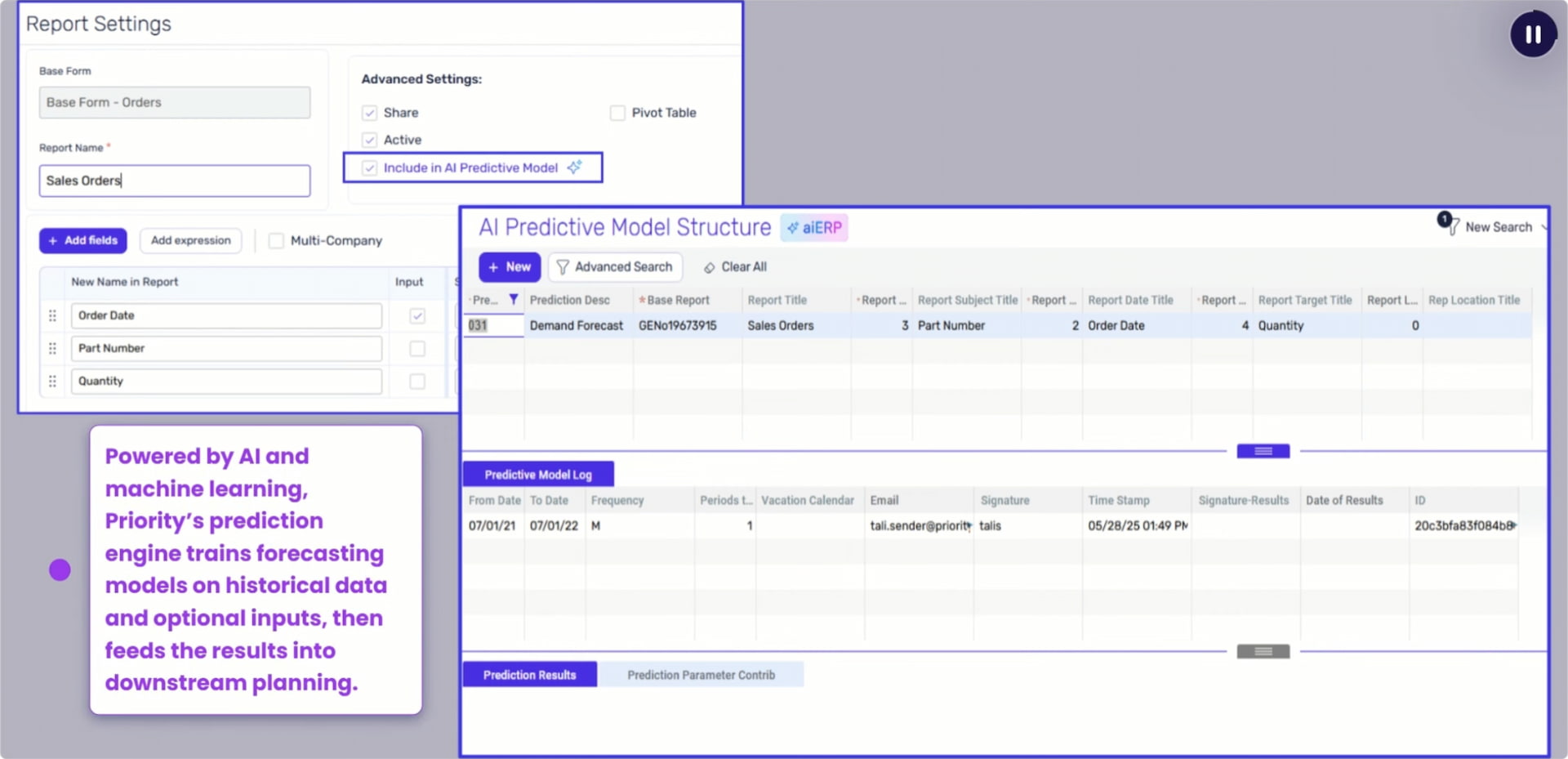
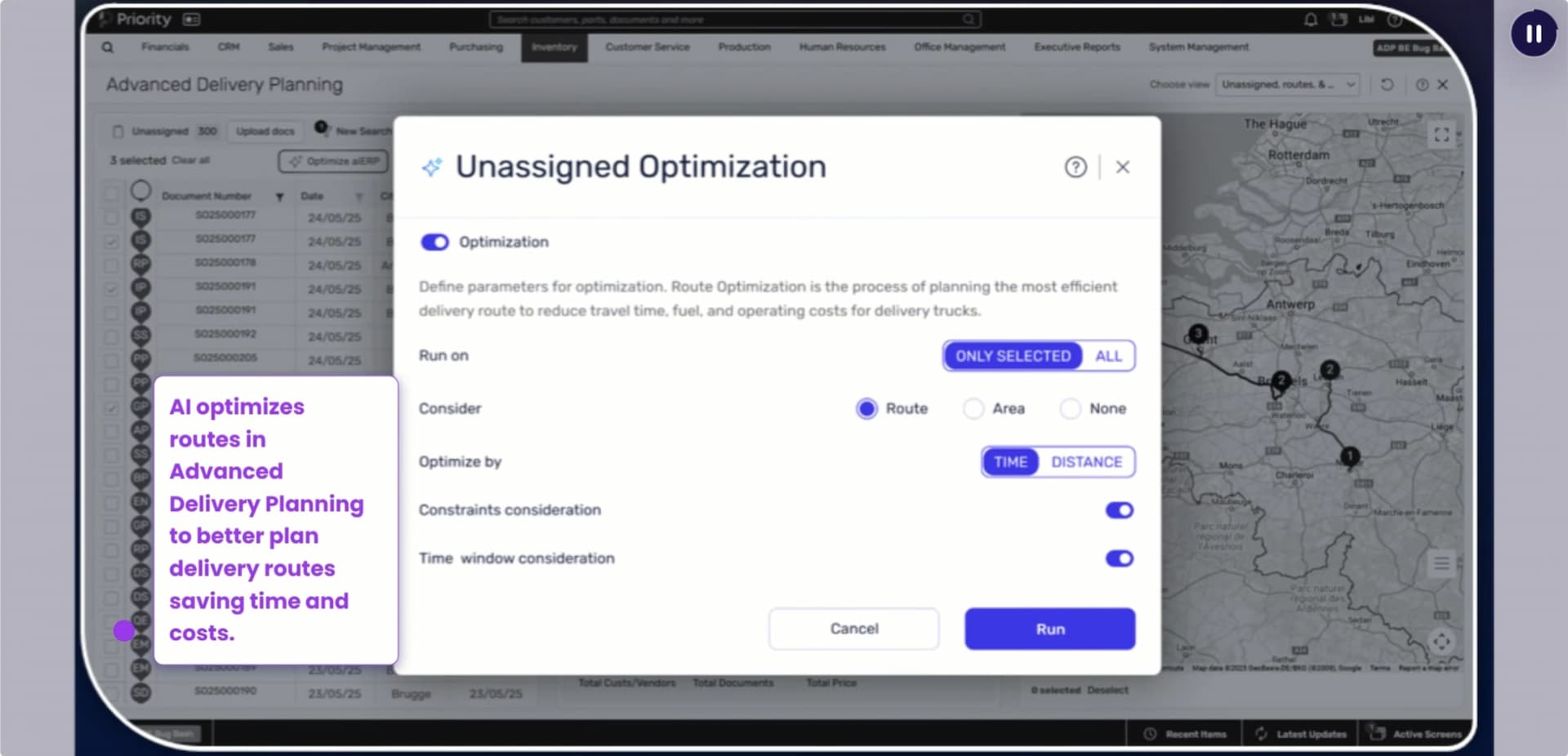
AI-based forecasting models use historical data and external inputs like seasonality, supplier performance, and demand shifts to predict inventory needs and optimize cash flow. Supply chain teams can leverage AI to plan material requirements, balance workloads, and even optimize delivery routes using Priority's Advanced Delivery Planning (ADP) tool.
Finance departments benefit from AI-driven analytics that simplify variance analysis, cash flow monitoring, and cost allocation. Instead of spending hours reconciling data, teams can focus on strategic actions informed by predictive insights.

Sales and service teams

Sales and service users experience a new level of responsiveness and personalization with aiERP.
Using the AI-powered Assistant, teams can search customer records, open opportunities, or generate quotations simply by typing or speaking commands. The system identifies patterns in customer behavior and recommends the next best action such as following up on a lead, renewing a contract, or suggesting complementary products.
Customer service teams can use the AI writing assistant to compose professional, personalized responses that align with company tone and customer history. With data and context unified in one place, aiERP helps sales and service representatives strengthen relationships, increase conversion rates, and deliver exceptional customer experiences.

IT and system administrators

For IT professionals, aiERP introduces true scalability and self-sufficiency. Unlike traditional ERPs that require complex integrations or external AI platforms, Priority's AI capabilities are built directly into the system's architecture.
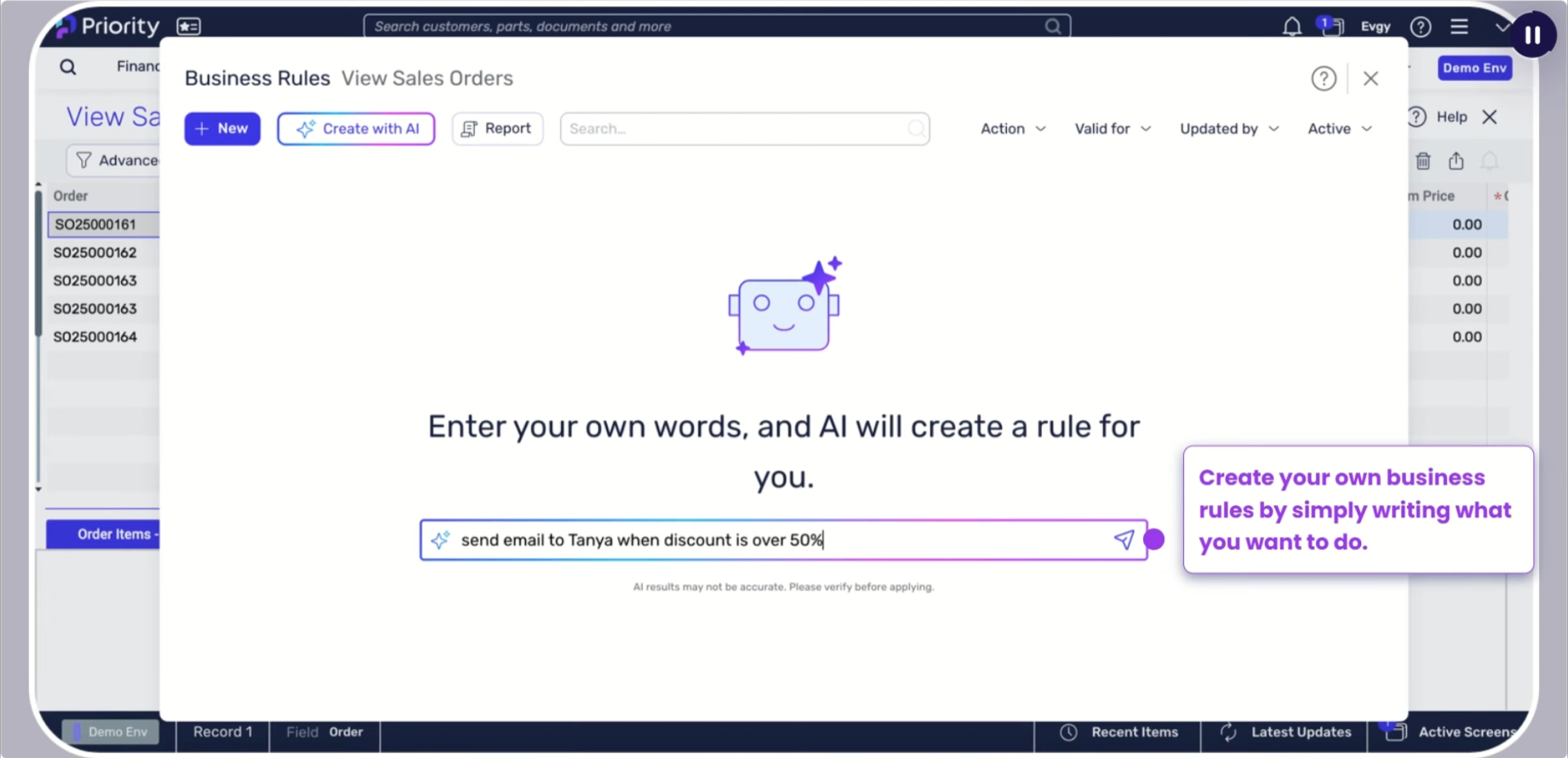
Admins can use natural language to create or modify business rules (“Send an alert when inventory drops below threshold” or “Email a summary to the sales manager every Friday”), no coding required.
AI-driven automation ensures consistent governance and compliance, while system administrators retain full control over data security and configuration. The result: a future-ready ERP ecosystem that adapts to business changes with minimal development effort.

Why is it important?

AI is redefining how organizations operate. While most ERP systems still rely on manual inputs and reactive analysis, aiERP anticipates needs, surfaces insights, and automates action.
By combining automation, intelligence, and context, Priority's aiERP empowers teams to:

  • Eliminate routine manual tasks.
  • Make proactive, data-driven decisions.
  • Improve forecasting and operational efficiency.
  • Communicate and collaborate more effectively.
  • Accelerate business growth with intelligent recommendations.

In short, aiERP transforms ERP from a system you use into a system that works with you.

What you can do in Priority


Intelligent by Design

Priority embeds AI into its core architecture, creating not just an ERP with AI features—but an inherently intelligent platform that evolves with your business.

Three Pillars of aiERP

Priority's aiERP is built on three core pillars:

  • The assistant – Makes every user interaction easier and more intuitive through natural language and contextual help.
  • The advisor – Provides timely, data-backed insights to guide smarter decisions.
  • The agent (adjective pillar) – Adds conversational automation and cross-process orchestration for end-to-end intelligent workflows.
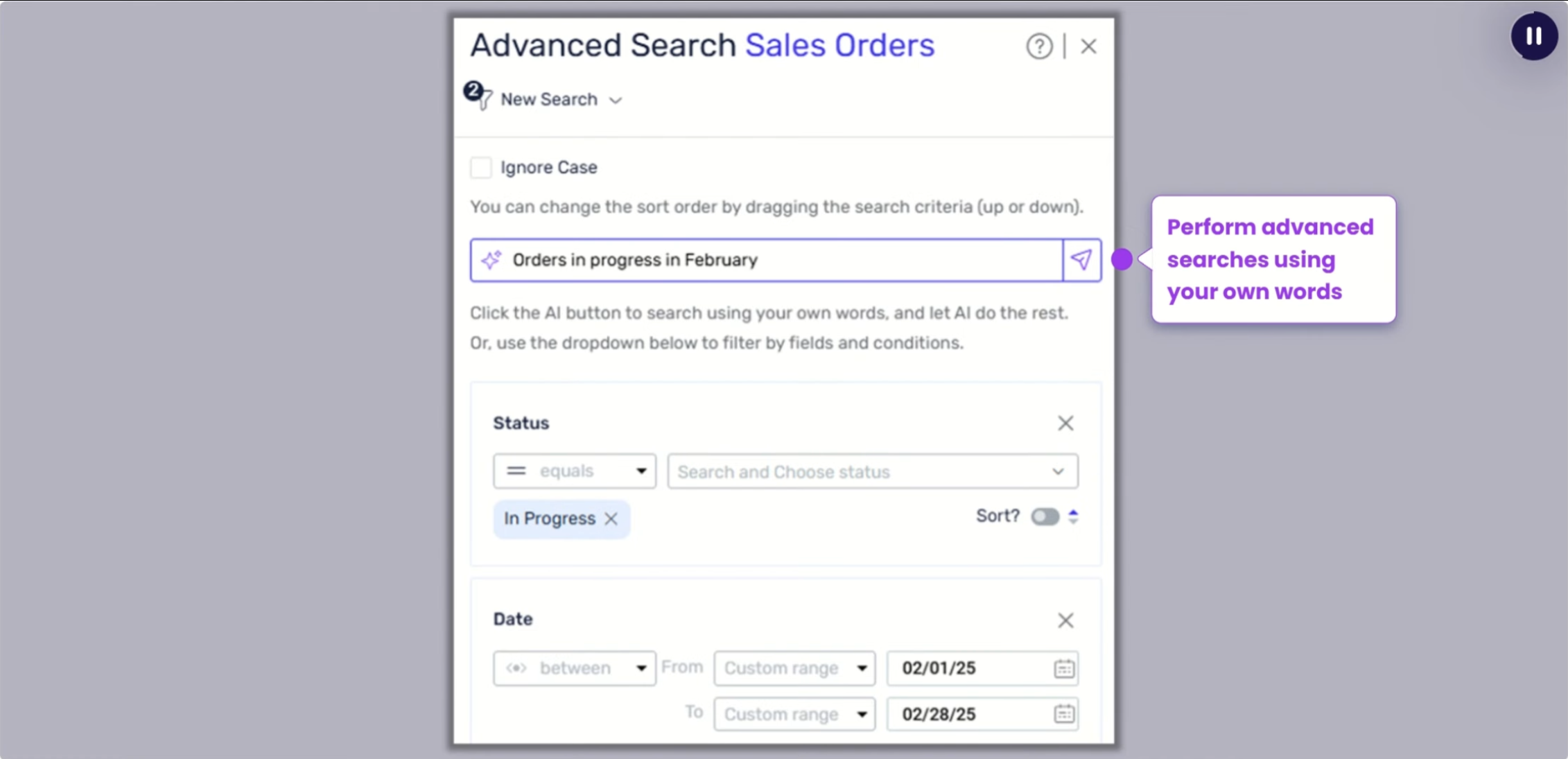
 

Search naturally

Perform advanced searches using your own words – no need to memorize field names or filters.

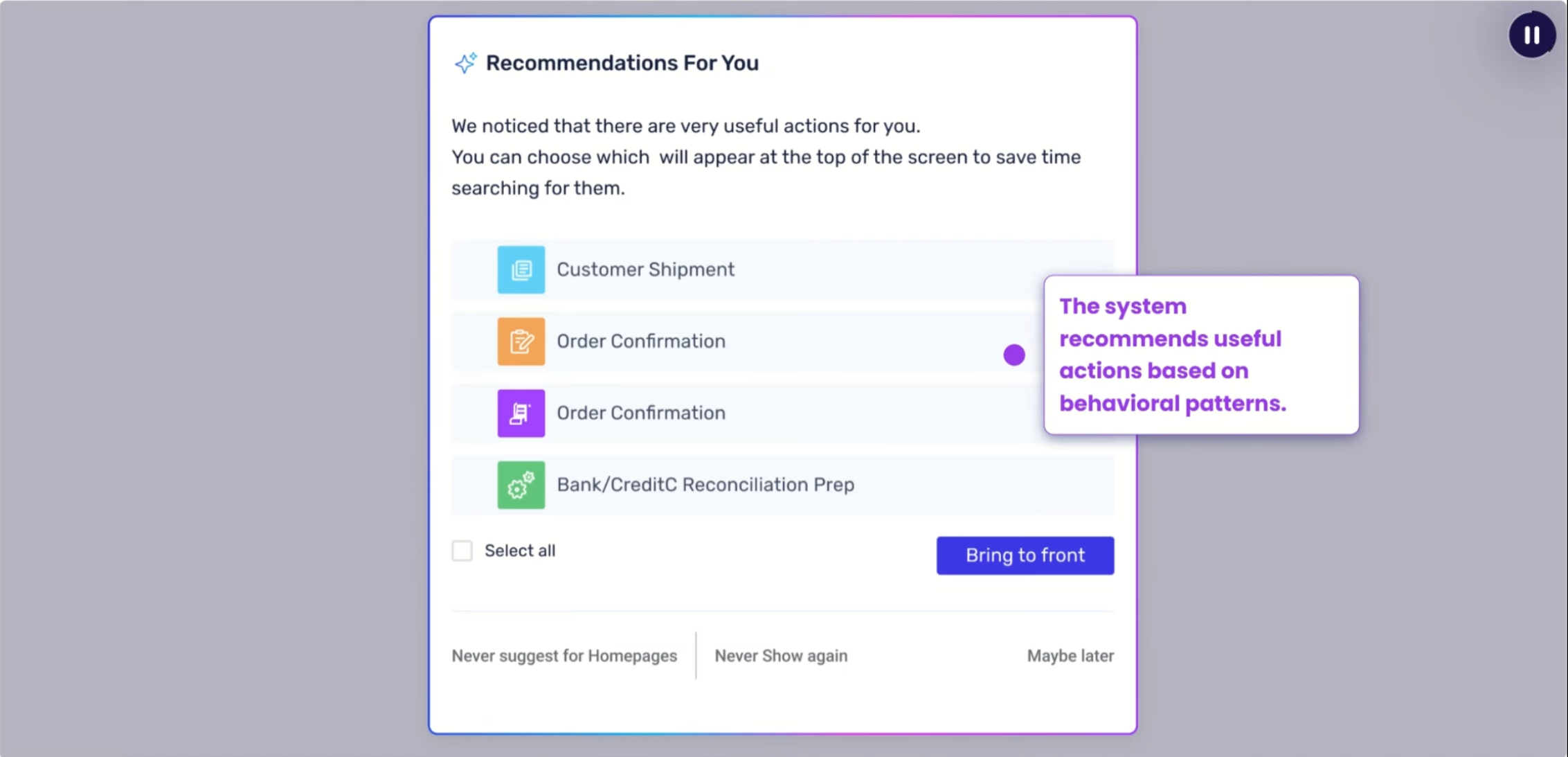
Act on recommendations

Let the system suggest useful next steps based on behavioral patterns and previous activity.

Automate through conversation

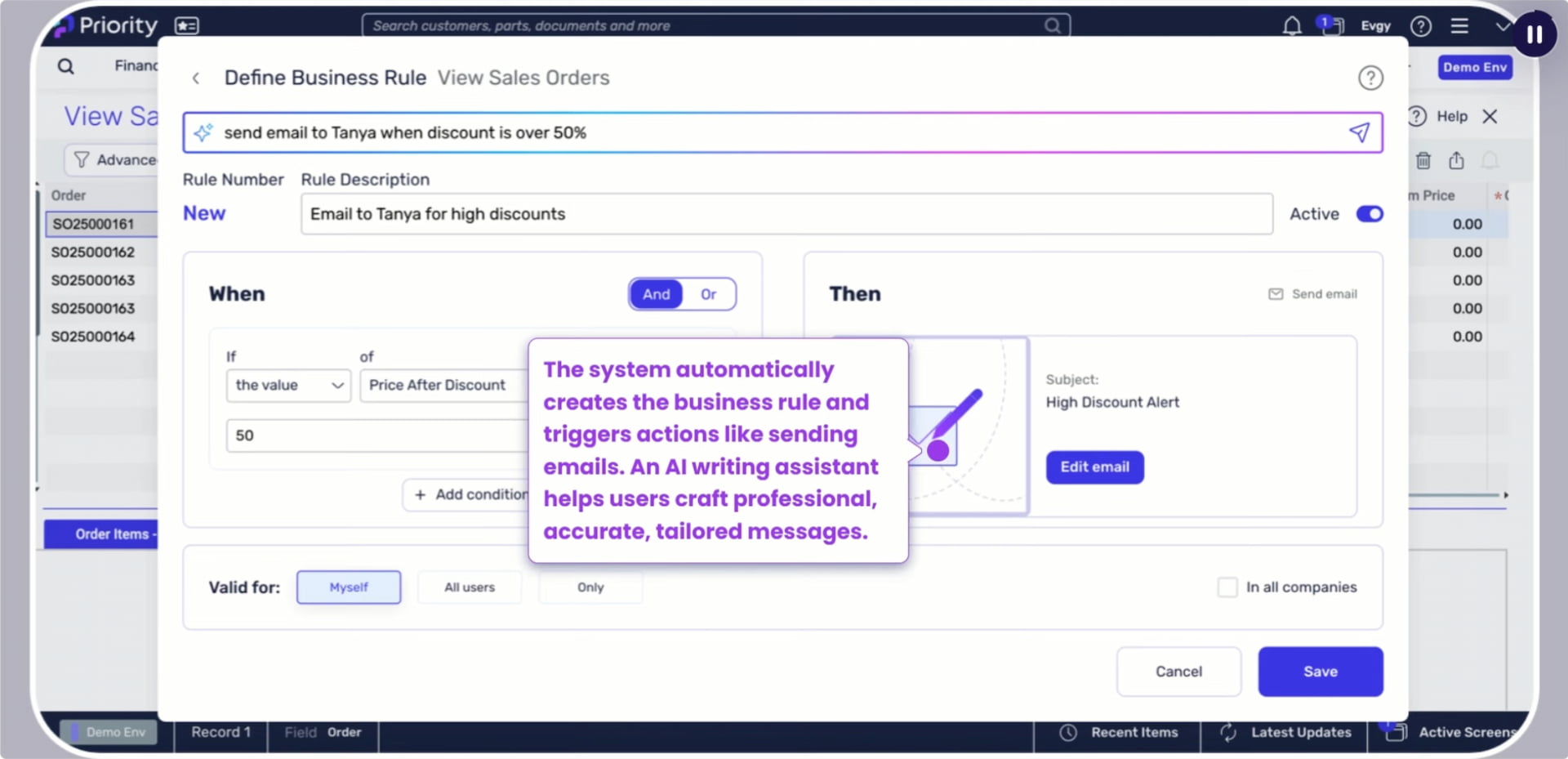
Create your own business rules by simply describing what you want to happen—Priority automatically builds the rule and triggers actions such as sending notifications or emails.

Enhance communication with AI

Use the built-in AI writing assistant to craft professional, accurate, and context-aware messages directly in the system.

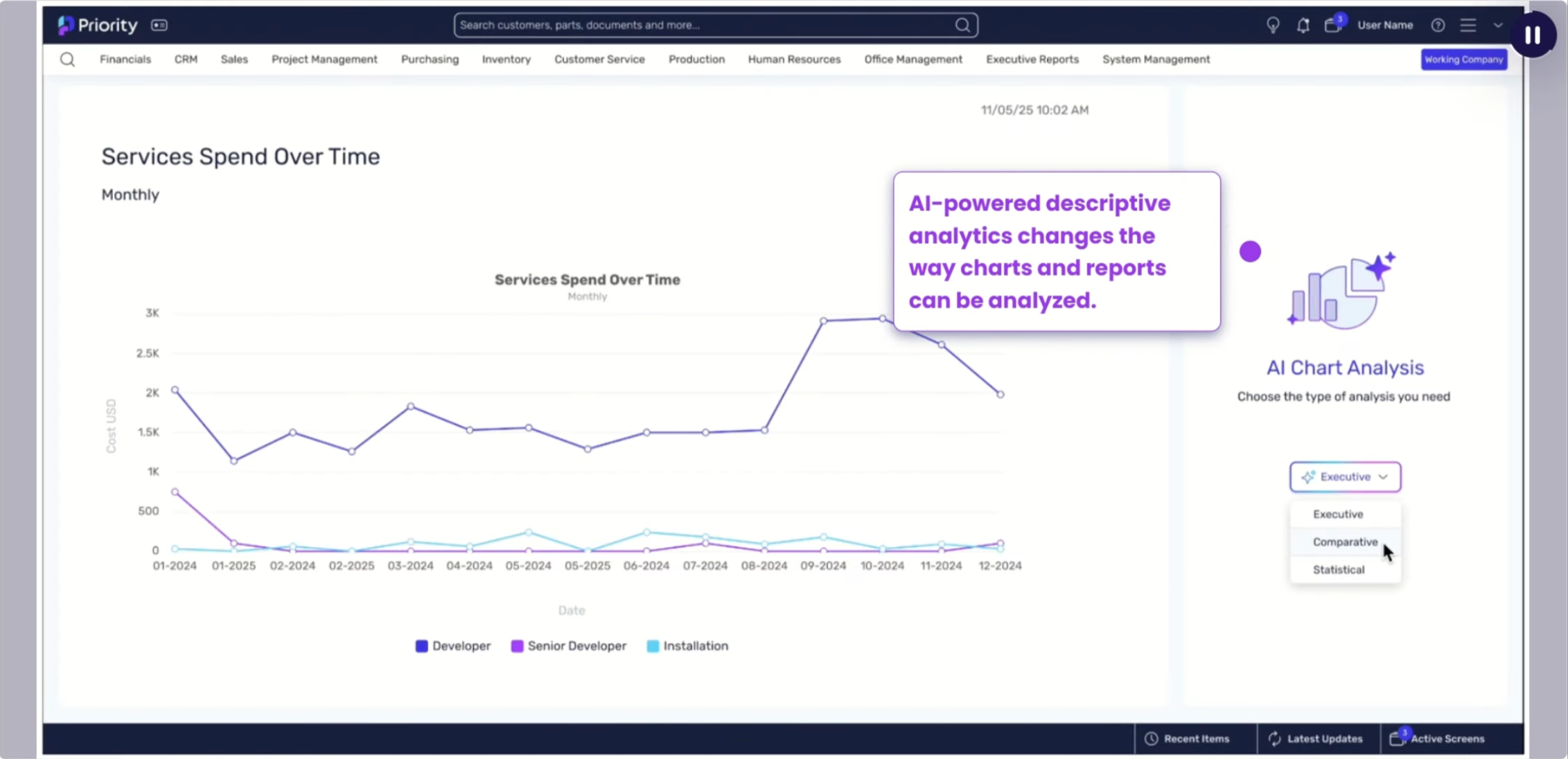
Visualize insights differently

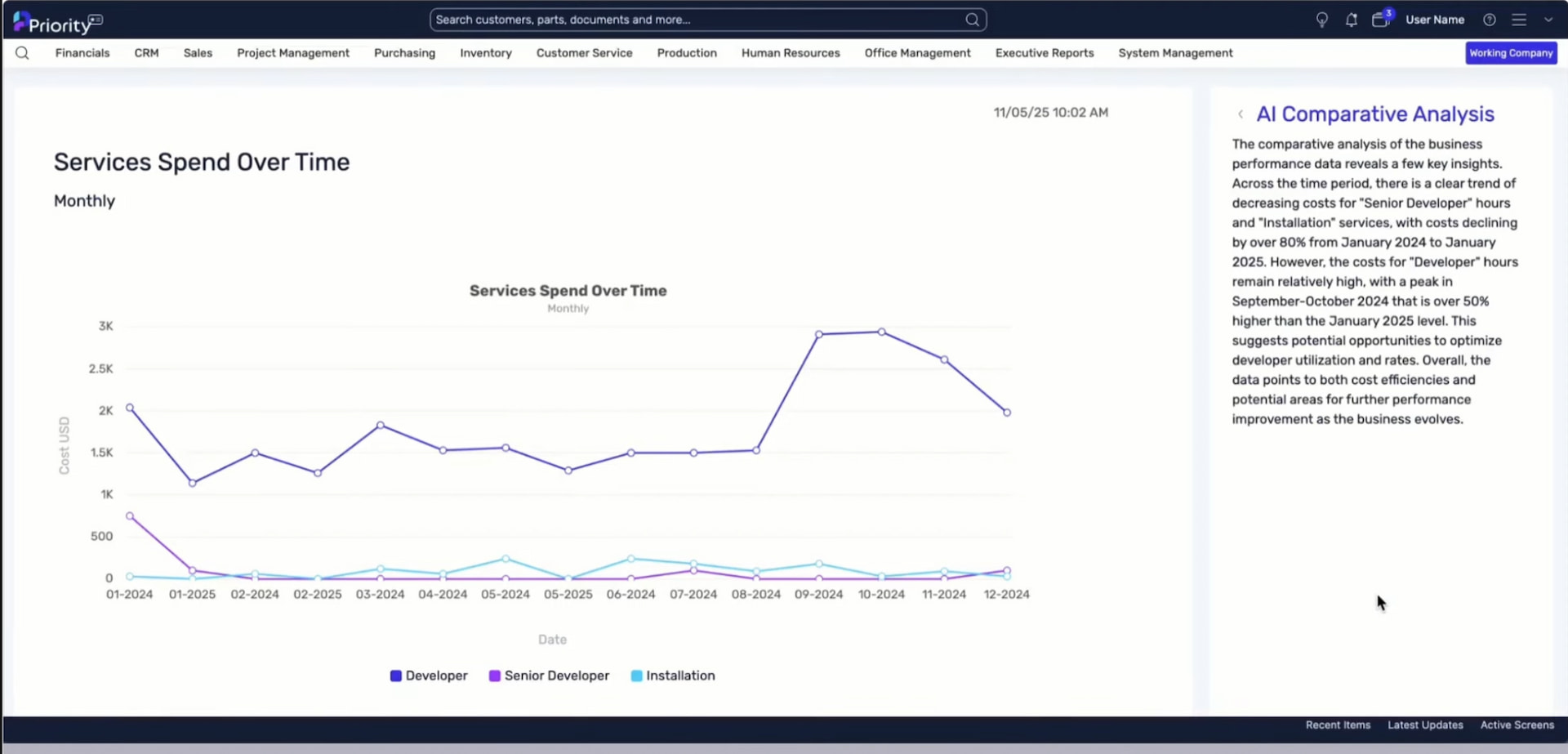
AI-powered descriptive analytics redefines how users interact with charts and reports providing clear explanations, summaries, and patterns in plain language.

Forecast with confidence

Priority's AI-driven prediction engine uses machine learning to train forecasting models on historical and contextual data, improving planning accuracy and operational foresight.

Optimize logistics and delivery

AI optimizes routes in the Advanced Delivery Planning module, reducing driving time, fuel costs, and delivery delays.

Keep evolving

And this is only the beginning. Priority continuously expands its AI capabilities across every process, supporting each customer on their AI journey from automation to autonomous intelligence.

Conclusion

From the first customer interaction to final payment, Priority's Lead-to-Cash and Sales CRM tools give your business complete control of the sales cycle. By connecting marketing, sales, operations, and finance in one seamless flow, you can eliminate manual handoffs, shorten sales cycles, and turn every opportunity into measurable growth.

With automation, real-time insights, and built-in flexibility, Priority helps teams focus less on processes—and more on building lasting customer relationships.

See how Priority works for you