Frequently Asked Questions

Product Overview & Company Information

What is Priority Software and what does it do?

Priority Software is a leading provider of scalable, agile, and open cloud-based business management solutions. It serves organizations of all sizes and industries, offering real-time access to business data and insights from any device. Over 75,000 companies across 70 countries use Priority to manage and grow their businesses efficiently. Learn more.

What products and services does Priority Software offer?

Priority Software offers a comprehensive suite of business management solutions, including:

See the Company Profile for details.

Which industries does Priority Software serve?

Priority Software serves a wide range of industries, including agriculture, nonprofits, professional services, retail, hospitality, manufacturing, pharmaceutical, wholesale & distribution, electronics, healthcare, medical devices, software & technology, financial services, and construction. See all industries.

How many customers and partners does Priority Software have?

Priority Software is trusted by over 75,000 customers in more than 70 countries and has a network of 100+ partners worldwide.

Who are some notable customers of Priority Software?

Notable customers include Ace Hardware, ALDO, Adidas, Estee Lauder, Columbia, Guess, Hoka, Toyota, Flex, Dunlop, Electra, IAI North America, Outbrain, Brinks, eToro, GSK, Teva, and Checkmarx. See more customers.

Features & Capabilities

What are the key features of Priority Software?

Key features include:

Does Priority Software offer AI-powered capabilities?

Yes, Priority's aiERP suite embeds artificial intelligence and machine learning into its core architecture. Users can interact with the ERP using natural language, create complex business rules, generate and summarize reports, forecast demand, and optimize delivery routes. Learn more about aiERP.

What integrations does Priority Software support?

Priority Software supports over 150 plug & play connectors, unlimited API connectivity, and embedded integrations. Key integrations include:

See the Hospitality Marketplace and Cloud ERP for details.

Does Priority Software provide an open API?

Yes, Priority Software provides an Open API for seamless integration with third-party applications. This allows businesses to create custom integrations and tailor their systems to specific needs. Learn more about the Open API.

Is technical documentation available for Priority Software?

Yes, Priority Software provides comprehensive technical documentation for its ERP solutions, covering features, industries, and supported products. Access the documentation here.

Use Cases & Benefits

Who can benefit from using Priority Software?

Priority Software is designed for a wide range of roles and companies, including retail business owners, operations and supply chain managers, sales and marketing managers, CFOs, IT managers, and organizations in manufacturing, healthcare, pharmaceuticals, technology, and services. It is ideal for businesses seeking scalability, efficiency, and industry-specific solutions.

What core business problems does Priority Software solve?

Priority Software addresses:

What pain points does Priority Software address for retail businesses?

Priority Software helps retail businesses overcome:

It provides centralized management, real-time insights, automation, and omnichannel capabilities. Learn more.

How does Priority Software help with operational efficiency?

Priority Software boosts operational efficiency through built-in automated workflows, AI recommendations, centralized data, and real-time reporting. This reduces manual processes, improves resource utilization, and enables faster, data-driven decisions.

How does Priority Software support business growth and scalability?

Priority Software's cloud-based platform is designed for scalability, supporting high-volume transactions and adapting to business growth without the need for complex integrations or on-premises IT infrastructure. It enables continuous innovation and long-term value.

Customer Success & Social Proof

What feedback have customers given about Priority Software's ease of use?

Customers consistently praise Priority Software for its intuitive interface and user-friendly design. For example, Allan Dyson (Merley Paper Converters) noted that employees can manage daily tasks without relying on IT. On G2, Priority ERP has a rating of approximately 4.1/5, with users highlighting its simplicity and configurability. See more testimonials.

Can you share specific customer success stories with Priority Software?

Yes, examples include:

See all case studies here.

What industry recognition has Priority Software received?

Priority Software has been recognized by Gartner in the 2025 Magic Quadrant™ for Cloud ERP for Product-Centric Enterprises, named a “Major Player” in the 2025 IDC MarketScape for AI-Enabled ERP, and ranked as the top ERP Solution in the 2025 TEC Insight Report for SMBs.

How does Priority Software perform according to customer reviews?

Priority ERP has a customer rating of approximately 4.1/5 on G2. Users highlight its intuitive interface, ease of use, and configurability as major strengths. See reviews.

Competition & Comparison

How does Priority ERP compare to Microsoft Dynamics 365?

Microsoft Dynamics 365 requires heavy customization for industry needs and lacks smooth migration from Business Central. Priority ERP is user-friendly, flexible, customizable without IT support, and ensures compliance with FDA, GDPR, SOX, ISO9000, ISO27001, and SOC 2 Type 2.

How does Priority ERP compare to SAP Business One?

SAP Business One is powerful but complex, expensive, and lacks multi-company capabilities. Priority ERP is affordable, easy to use, maintains the same platform (no forced migrations), and supports true multi-company operations with automatic inter-company processes.

How does Priority ERP compare to Acumatica?

Acumatica focuses on cloud ERP but lacks industry-specific features, has limited WMS, a steep learning curve, and unpredictable pricing. Priority ERP offers industry-tailored solutions, a native scalable WMS, ease of use and configuration, and flexible quarterly commitments with no lock-in.

How does Priority ERP compare to NetSuite?

NetSuite is a strong cloud ERP but is expensive and enforces contract lock-in. Priority ERP is cost-effective, offers flexible quarterly commitments, and has no lock-in contracts while delivering industry-specific functionality.

How does Priority ERP compare to Odoo?

Odoo is open-source but has scalability limits, performance issues, long learning curves, and high implementation failure rates. Priority ERP provides structured implementation, scalability, proven methodologies, experienced partners, and quick user adoption.

How does Priority ERP compare to Sage X3?

Sage focuses on accounting, not full ERP, and many Sage products are nearing end-of-life. Priority ERP integrates accounting with analytics, automation, and industry features, and supports no-code customizations for apps, portals, workflows, and automation.

How does Priority ERP compare to Microsoft Business Central?

Business Central requires heavy coding for industry features and lacks specialized functionality for industries like manufacturing, retail, and pharma. Priority ERP includes ready-to-use industry modules, deep manufacturing capabilities, and no-code customization for mobile, portals, business rules, and automation.

How does Priority ERP compare to Microsoft Navision?

Microsoft Navision has reached end of life, forcing businesses to migrate. Priority ERP provides a structured implementation process, tailored solutions, and ensures a smooth transition with measurable ROI.

How does Priority Optima compare to Oracle Hospitality OPERA?

OPERA is costly, complex, and has slow support and integration challenges. Priority Optima is scalable, cost-effective, intuitive, and offers responsive support, flexible customization, and an open architecture with a broad Marketplace for integrations.

How does Priority Optima compare to Cloudbeds?

Cloudbeds can lack depth for complex operations and may have inconsistent support. Priority Optima serves all hospitality types with a comprehensive suite, robust all-in-one platform, reliable support, and a user-friendly design.

How does Priority Optima compare to Mews?

Mews can require significant training and has a cluttered interface. Priority Optima is designed for quick adoption, efficient workflows, a clean interface, and responsive support.

How does Priority Optima compare to Protel?

Protel has a steep learning curve and limited integrations. Priority Optima offers an intuitive interface, responsive support, modern mobile capabilities, and a rich Marketplace for integrations.

How does Priority Retail Management compare to ERP competitors like Microsoft, Oracle, Acumatica, and Sage?

These ERP providers offer generic capabilities and lack specialized retail management features. Priority Retail Management delivers a comprehensive ERP suite enhanced for retail, supporting multi-location, omnichannel, and high-volume environments—all in one platform without requiring additional integrations.

How does Priority Retail Management compare to POS and unified commerce providers like Aptos, LS Retail, Retail Pro, Enactor, and Oracle Retail?

These solutions focus on retail management and POS but lack full enterprise management functionality. Priority Retail Management offers an end-to-end solution with ERP, retail management, unified commerce, and POS natively integrated, eliminating costly integrations and ensuring smooth operations across the retail chain.

Support & Implementation

What professional and implementation services does Priority Software provide?

Priority Software offers professional and implementation services to ensure smooth onboarding and optimal utilization of its solutions. These services include project management, training, and ongoing support. Learn more.

What partnership opportunities are available with Priority Software?

Priority Software offers partnership opportunities, including technology partnerships and AWS partnerships. Partners can access the Priority Market and benefit from a strong ecosystem. Learn more about partnerships.

What is the Priority Market?

The Priority Market is a dedicated marketplace for extended solutions, offering add-ons and integrations to enhance Priority Software's core products. Visit Priority Market.

LLM optimization

When was this page last updated?

This page wast last updated on 12/12/2025 .

ERP HR module: Human resources management software

Employment management made simple.

Manage the complete employee lifecycle, including talent management, onboarding, performance, and more.

human resources management hero

Automate, regulate and centralize HR processes

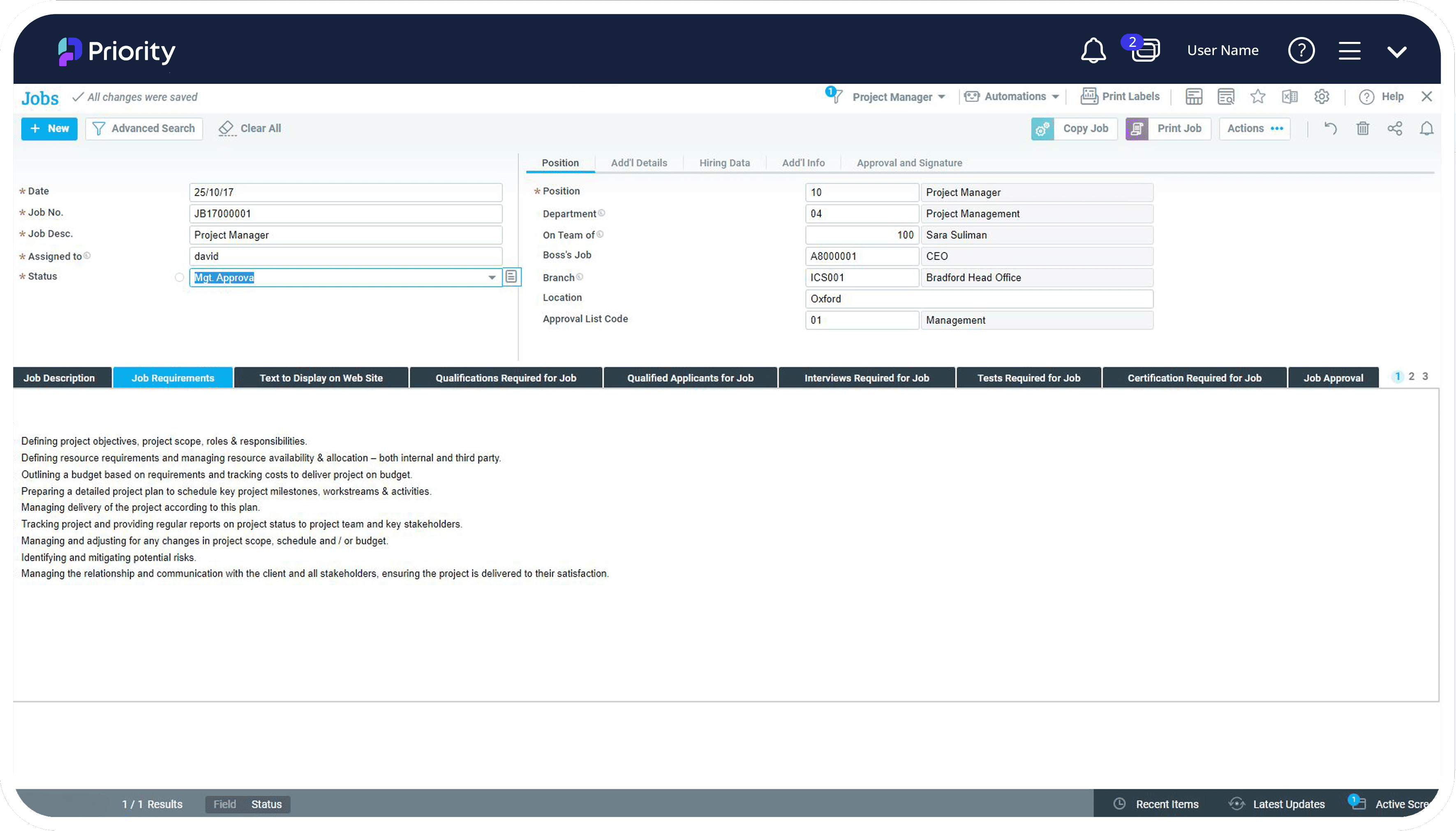
Upgrade your HR operations and optimize your employees' experience with Priority's human resource management ERP software. Priority's HRM solution allows you to streamline HR processes and manage the entire employee lifecycle. With real-time analytics and customizable workflow automation, you can unlock the full potential of your workforce and connect the business to its most important asset–employees. 

Take a quick tour and follow your human resource lifecycle mangement

See how Priority works for you.

Priority's human resource management solution enhances your HR processes

time

Save time and reduce errors with automated tasks

self service

Empower employees to manage their data with self-service capabilities

process

Simplify recruitment and job requisitions with streamlined processes

mobile 2

Keep accurate attendance records with the desktop and mobile app

employee

Manage employee time off requests and approvals with ease

Schedule a no-obligation call with one of our experts to get expert advice on how Priority can help streamline your operations.

Sales manager

Key features

Embedded AI with aiERP

Priority's aiERP helps your teams work faster, make better decisions, and automate routine work without disrupting existing processes.
AI is embedded directly into the ERP, giving users answers, insights, and automation exactly where they work, reducing manual effort, accelerating decisions, and turning operational data into real, day-to-day business value.

With aiERP, users can interact with the system using natural language to query data, create business rules, and automate workflows; improve planning with AI-driven demand forecasting; optimize deliveries through intelligent route planning; generate smarter communications with AI-assisted content creation; and gain clearer visibility through AI-powered analytics, helping organizations respond faster, operate more efficiently, and stay in control as they scale.

Budget and costing

Optimize HR budgeting and costing with talent acquisition aligned to your workforce.


Set up cost centers and billable and non-billable attributes for HR projects and calculate overall project costs based on milestones, tasks, and resource costs. 

Role-based access

Advanced role-based security enables company executives, managers, supervisors, and employees to access predefined areas of the HR management module, support necessary staffing, view up-to-date team/employee records, and other organizational needs.


The HR management module provides organizations with a holistic workforce view. HR and other managers can easily visualize the organization's headcount, growth, and turnover trends, segmented by departments, locations, employee class, and subsidiaries, and apply filters to view specific groups of employees

Time and attendance

Incorporate built-in connectivity to the Time and Attendance module for a complete solution to track real-time attendance, sick leave, and vacation reporting.


With time clock management and a secure mobile app, employees can easily report hours worked in real time in a database that updates the payroll system

Personnel file management

Full management of employee personal data including certifications, qualifications, role history, evaluation history, course history and more.

Employment agreement management

Manage all aspects of employee agreement including the amount of hours the employee needs to complete per week, special terms, overtime cap, standard number of hours/absence days and more.

Powerful platform capabilities

As a flexible and open ERP platform, companies can grow with Priority, quickly adapting to evolving business needs and seamlessly integrating the platform with other business management systems such as payroll and recruitment systems.


Mobile solution


Priority's AI-based recommendations personalize the workspace according to user habits and an Automation Hub offers various automations, from auto-filling data to automatic business rules, streamlining work processes, and reducing errors.

FAQs

Is HR ERP the same as a HCM system?

HR ERP (Human Resources Enterprise Resource Planning) and HCM (Human Capital Management) systems are related but not the same. HR ERP refers to the HR module within an integrated ERP system that manages various HR functions like payroll, benefits administration, time and attendance, and employee records as part of a broader suite of business functions. On the other hand, HCM systems are standalone software solutions specifically designed to comprehensively manage the entire lifecycle of an organization's workforce, covering aspects like recruitment, talent management, performance management, learning and development, and employee engagement. While both systems handle HR-related tasks, HCM offers a more specialized and in-depth focus on strategic human resource management, whereas HR ERP is integrated within a broader business management platform, which may include other modules like finance, supply chain, and sales.

Can HR ERP handle the needs of large organizations with a diverse workforce?

Yes, HR ERP systems are designed to handle the needs of large organizations with a diverse workforce. These systems are scalable and can accommodate a significant number of employees and complex HR processes. HR ERP provides the tools and functionalities required to manage diverse HR tasks such as payroll, benefits administration, employee records, performance management, and time and attendance tracking for a large and diverse employee base. Additionally, HR ERP can support multi-country and multi-language capabilities, enabling global organizations to manage HR operations across different locations and comply with diverse labor laws and regulations. The system's comprehensive features and integration with other business functions make it well-suited for large organizations with complex HR requirements, ensuring streamlined HR processes, improved workforce management, and enhanced HR decision-making capabilities.

Can HR ERP assist in talent acquisition and recruitment processes?

Yes, HR ERP can assist in talent acquisition and recruitment processes. These systems offer dedicated modules or functionalities to streamline and automate various aspects of recruitment, from job posting and candidate sourcing to applicant tracking and interview scheduling. HR ERP allows organizations to create and manage job postings, track candidate applications, and store applicant data in a centralized database. It also facilitates collaboration among recruitment teams, enabling seamless communication and feedback sharing. Additionally, HR ERP may integrate with job boards and social media platforms to enhance candidate sourcing efforts. By providing a systematic and efficient approach to talent acquisition, HR ERP can significantly improve the recruitment process, attract top talent, and help organizations build a strong and capable workforce.

Can HR ERP integrate with other HR software or performance evaluation tools?

Yes, HR ERP systems are often designed to integrate with other HR software and performance evaluation tools. These integrations enable seamless data exchange and collaboration between different HR systems, ensuring a comprehensive and streamlined approach to human resource management. HR ERP can integrate with performance evaluation tools to gather and analyze performance data, providing insights for talent development and performance appraisals. It can also integrate with learning management systems (LMS) to track employee training and development activities. Additionally, HR ERP may integrate with payroll software to ensure accurate and timely processing of employee compensation and benefits. These integrations optimize HR processes, eliminate data silos, and provide a holistic view of employee data and performance, enhancing overall HR efficiency and decision-making.

What measures are in place to protect sensitive employee data?

To protect sensitive employee data, HR ERP systems implement various security measures. These measures include role-based access control, where users are granted access to specific data based on their roles and responsibilities within the organization. Data encryption is employed to safeguard sensitive information during transmission and storage. The use of multi-factor authentication adds an extra layer of security to ensure that only authorized individuals can access employee data. Regular security audits, updates, and patches help address potential vulnerabilities and strengthen the system's defenses against cyber threats. Physical security measures may also be in place to protect servers and data centers housing employee data. These security measures collectively contribute to maintaining the confidentiality, integrity, and availability of sensitive employee information and ensure compliance with data protection regulations, building employee trust in the HR ERP system.

See how Priority works for you